




Flying Nonstop from Tasmania to Western Australia
Australia is home to some of the world’s longest domestic air routes, yet one of the most overlooked is Virgin Australia’s nonstop service between Hobart and Perth. Stretching across the southern edge of the continent, this journey links Tasmania with Western Australia in a single flight, traversing the rugged wilderness of Tasmania, the vast Great Australian Bight and thousands of kilometres of sparsely populated coastline before arriving on Australia’s west coast.
For aviation enthusiasts, it is an especially interesting route. Unlike many transcontinental services operated by larger aircraft, Virgin Australia assigns its dependable Boeing 737-800 to this sector, making it one of the longest scheduled domestic Boeing 737 flights in Australia. Spending almost five hours aboard one of Australia’s aviation workhorses presents the perfect opportunity to assess whether Virgin Australia’s hybrid full-service model continues to offer good value in 2026.
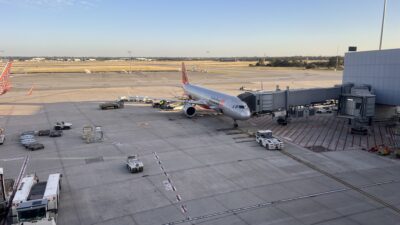
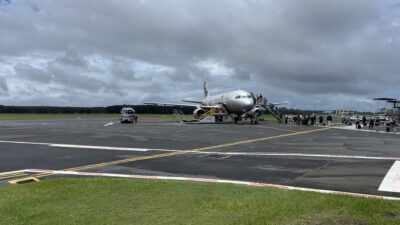
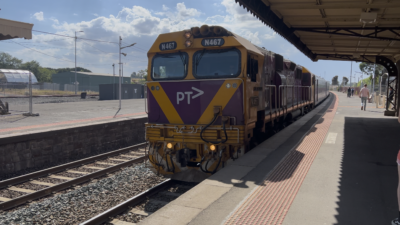
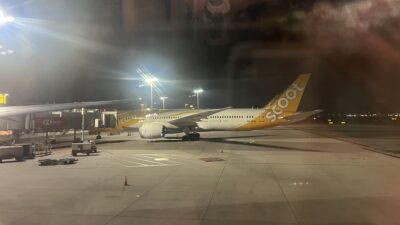
My journey also marked the conclusion of several incredible weeks travelling around Australia’s east coast during the peak of the Australian summer. From tropical Far North Queensland to Brisbane, Byron Bay, Melbourne, Geelong and across Bass Strait aboard the Spirit of Tasmania before spending several days exploring Hobart, this flight would complete an unforgettable circuit of Australia before returning home to Perth.
Would Virgin Australia provide a smooth end to an outstanding trip, or would Australia’s longest domestic Boeing 737 route expose weaknesses in the airline’s product? There was only one way to find out.
Hobart Airport: A Mixed First Impression
Unlike many Australian airports located well beyond their respective city centres, Hobart Airport is easily reached from downtown Hobart via the dedicated SkyBus service.
After checking out of my centrally located hotel, I boarded the airport bus at a stop located virtually outside the front entrance. One pleasant surprise compared with Melbourne’s SkyBus network is that Hobart offers multiple CBD pickup locations, making the service considerably more convenient for visitors staying throughout the city.
Although the fare of $24 initially seems expensive, the value becomes easier to justify when considering the short twenty-minute journey and the convenience of direct city access. On this particular afternoon I was the only passenger aboard, making for a remarkably comfortable transfer to the airport.
The smooth beginning, however, would not last.

Virgin Australia’s Check-in Process Falls Short
Unfortunately, the most disappointing aspect of the entire journey occurred before I even reached security screening.
While Virgin Australia’s onboard product has generally impressed me over recent years, the airline’s ground experience at Hobart Airport left much to be desired.
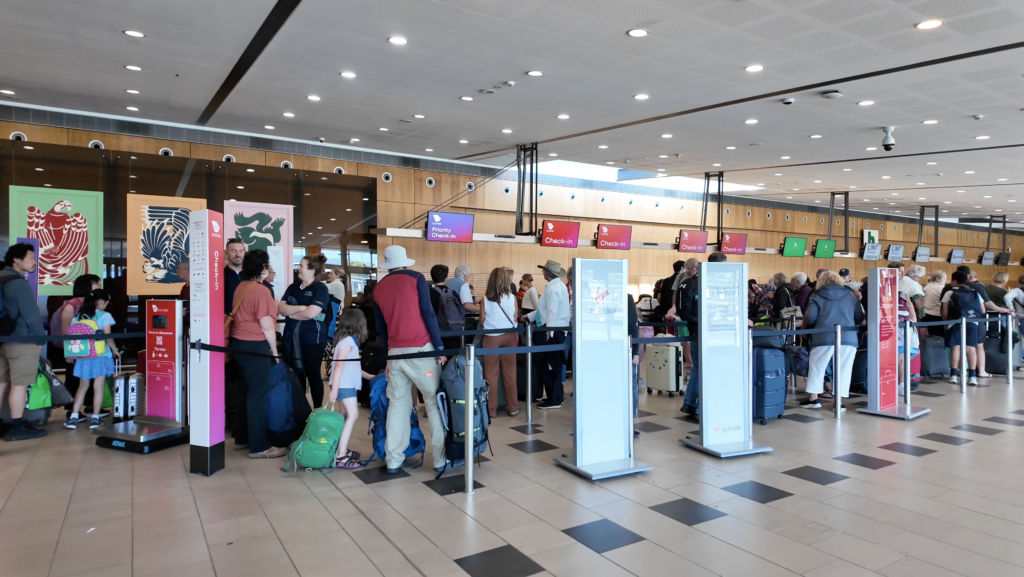
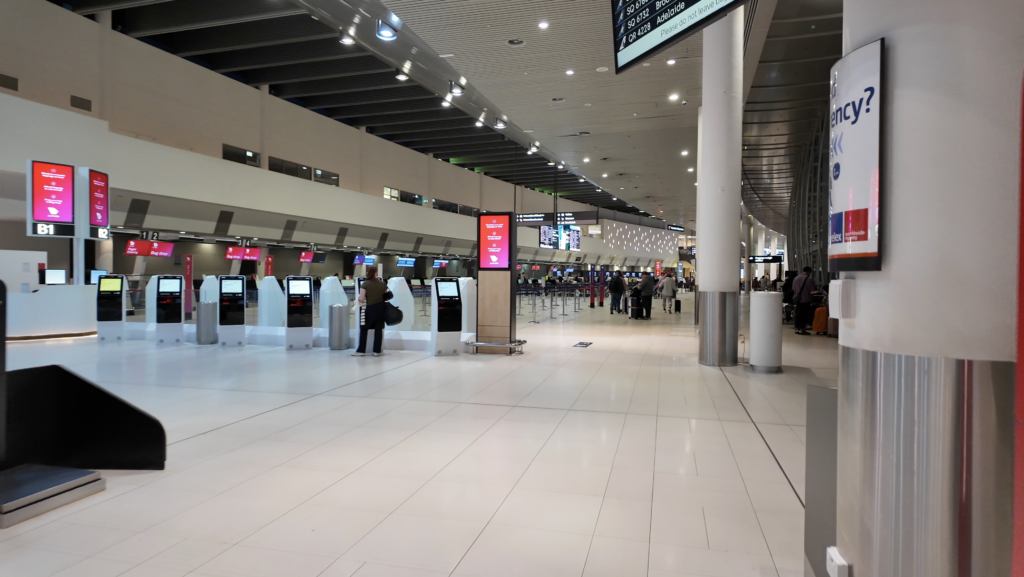
Upon arriving at the terminal I was greeted by an enormous queue stretching well beyond the designated check-in area. Rather than opening well in advance of departure, the airline’s counters remained closed until approximately ninety minutes before departure despite several flights requiring manual processing.
The result was predictable.
Passengers waited over thirty minutes simply for the counters to open before enduring another lengthy queue to actually check in. Overall, nearly an hour passed before I finally received my boarding pass and baggage receipt.
For a busy summer travel period, particularly during Australian school holidays, this simply wasn’t good enough.
Unlike airports featuring automated self-service bag drop facilities, Hobart still relies heavily on traditional staffed check-in counters. When multiple departures are scheduled within similar timeframes, the system quickly becomes overwhelmed.
In my view, Virgin Australia needs to significantly improve its staffing levels or alternatively open check-in much earlier for peak departure periods. For many passengers, particularly families or travellers unfamiliar with the airport, such lengthy waits unnecessarily increase stress before a flight has even begun.
Fortunately, once the frustrating check-in process concluded, the remainder of the airport experience improved considerably.
Security Screening
Thankfully, security screening restored some confidence.
Despite the crowded terminal, security moved efficiently with minimal delays. Modern CT scanners allowed electronics and liquids to remain inside bags, greatly simplifying the screening process compared with older systems still found at some regional airports.
Within only a few minutes I was through security and into the departures area.
Hobart Airport Departures
Although Hobart Airport has undergone gradual expansion over recent years, it remains one of Australia’s more compact capital city airports.
That compact footprint becomes particularly noticeable during busy holiday periods.
The terminal felt crowded almost immediately after entering the departures area, with limited seating available around several gates. Food options also remain somewhat limited compared with larger Australian airports, especially if you’re looking for affordable fast food before boarding.
Unlike Perth, Melbourne or Brisbane, Hobart currently lacks a Virgin Australia Lounge, meaning eligible passengers have no premium facility available before departure.
Considering the increasing popularity of Tasmania as a tourist destination, airport infrastructure will likely require further expansion in coming years.
Better scheduling of departures would also help reduce congestion, as multiple flights appeared to be departing within a relatively narrow timeframe, placing significant pressure on available facilities.
Despite these shortcomings, boarding would thankfully prove far smoother than the check-in experience.
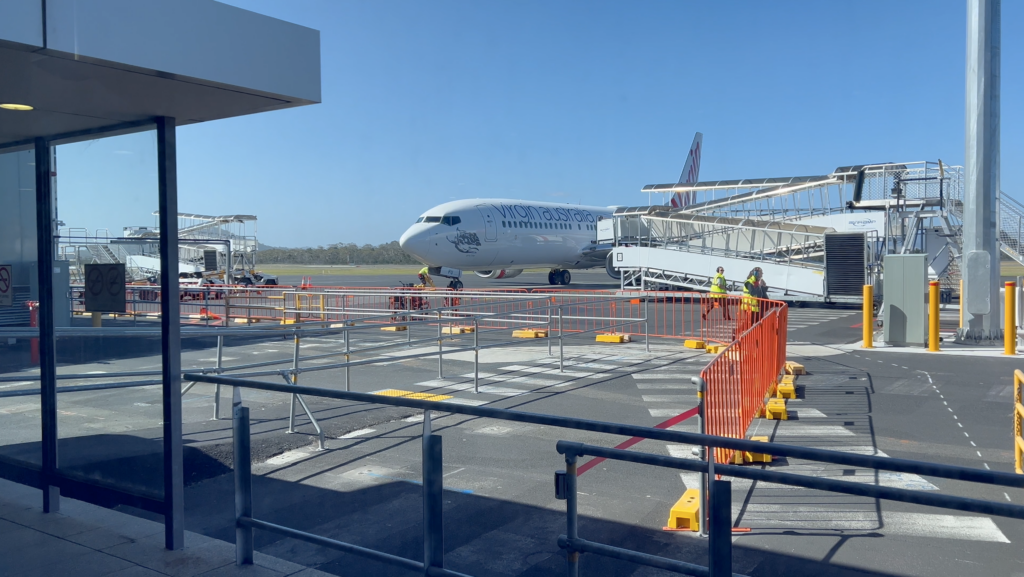
Boarding Right on Schedule
One pleasant surprise came when boarding commenced exactly as scheduled.
After the earlier frustrations at check-in, it was reassuring to see Virgin Australia’s operational performance remained strong. The aircraft boarded efficiently and pushed back slightly ahead of schedule, allowing an early departure from Hobart.
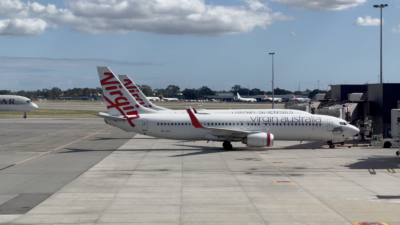
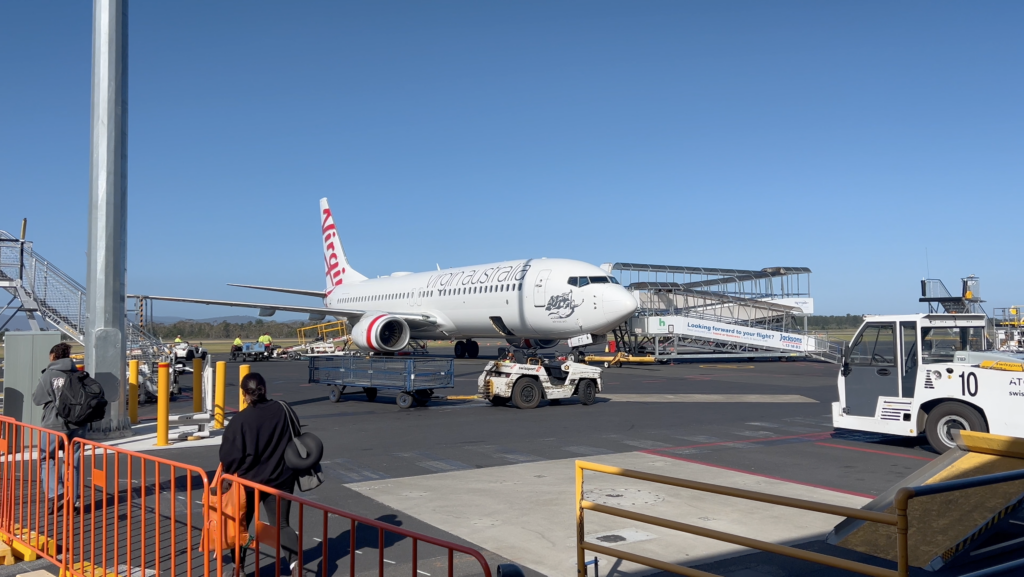
Today’s aircraft was one of Virgin Australia’s familiar Boeing 737-800s.
Although gradually being supplemented by newer Boeing 737 MAX 8s and Embraer E190-E2 aircraft, the Boeing 737-800 continues forming the backbone of Virgin Australia’s domestic network.
For passengers, it remains a comfortable and dependable aircraft for medium and long-haul domestic flying, even if its age is beginning to show compared with Virgin’s newest additions.

Virgin Australia’s Boeing 737-800 Cabin
Stepping onboard, the cabin presented the familiar Virgin Australia interior many domestic travellers will instantly recognise.
Configured with Business Class at the front and Economy throughout the remainder of the aircraft, today’s cabin was clean, tidy and well maintained.
While the interior lacks some of the modern touches now appearing on Virgin Australia’s newer fleet—including USB charging ports and updated cabin fittings—it still offers a pleasant travelling environment.
Seat comfort remains one area where Virgin Australia generally outperforms its low-cost competitors.
The seats provide noticeably better cushioning than Jetstar’s standard economy seating, making longer sectors such as Hobart to Perth considerably more comfortable. However, the aircraft’s age does become apparent through the absence of newer passenger conveniences increasingly expected in 2026.
Once settled into my seat, anticipation quickly built for what promised to be one of the highlights of the entire journey—a spectacular departure over southern Tasmania before tracking across some of Australia’s most remote and breathtaking wilderness.

Spectacular Departure Over Tasmania
One of the biggest advantages of securing a daytime departure from Hobart is the opportunity to witness some of Australia’s most spectacular aerial scenery immediately after take-off. Unlike many domestic flights that quickly climb over suburban landscapes, this route heads west across Tasmania’s rugged interior, offering remarkable views that few passengers ever experience.
As our Boeing 737-800 rotated from Hobart Airport and climbed away from the Derwent River, the scenery quickly transformed from rolling farmland into one of Australia’s largest remaining wilderness areas.
Before long, we were passing over the breathtaking Franklin–Gordon Wild Rivers National Park.
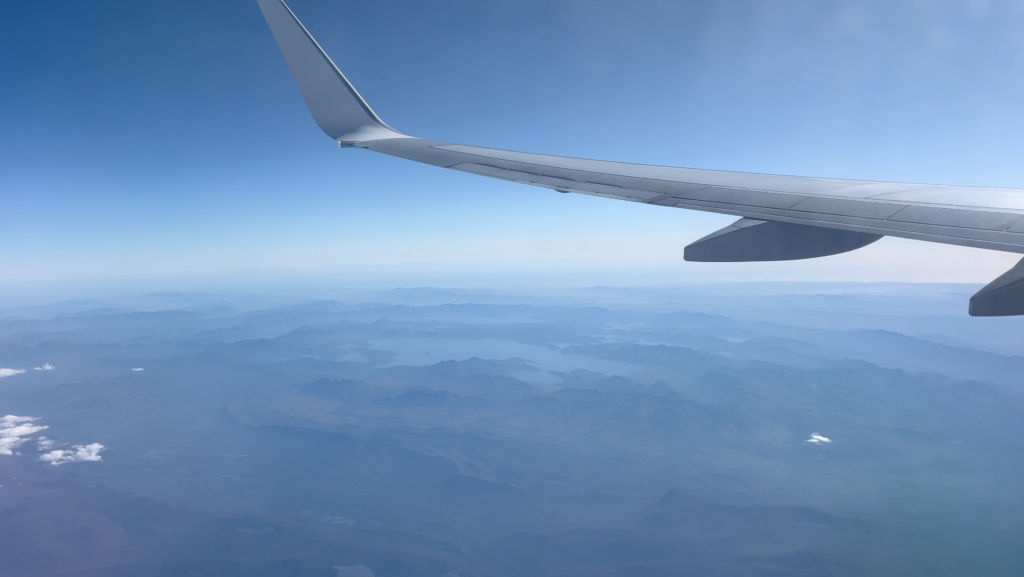
Covering more than 4,400 square kilometres, this UNESCO World Heritage-listed wilderness remains one of the most pristine and untouched regions anywhere in Australia. Dense temperate rainforest, jagged mountain ranges, winding rivers and vast expanses of protected wilderness stretched to the horizon beneath us.
From 32,000 feet, it served as a timely reminder of just how incredibly diverse Australia’s landscapes really are. Within less than twenty minutes of departing Hobart, the view below had already become one of the visual highlights of the entire flight.
For window seat passengers, this departure alone makes the route well worth flying during daylight hours.
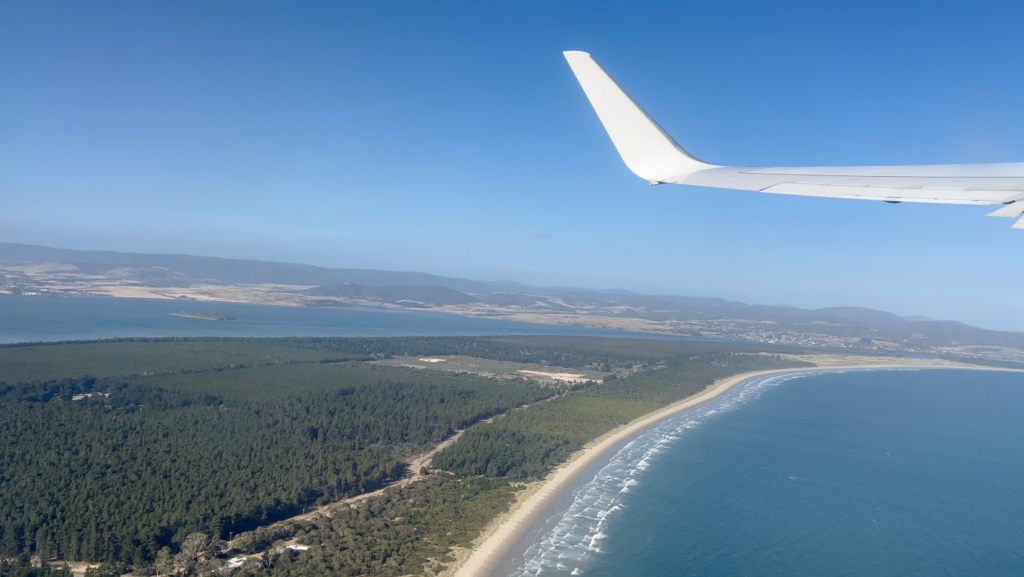
Cruising Towards Western Australia
Once clear of Tasmania, the aircraft settled into its initial cruising altitude of 32,000 feet before continuing west across Bass Strait and the vast Southern Ocean.
Unlike many east coast routes where the landscape continually changes below, this sector spends several hours crossing sparsely populated ocean before eventually making landfall again in Western Australia.
It’s one of those flights where the onboard experience becomes just as important as the scenery.
With almost five hours in the air, comfortable seating, entertainment and food all become much bigger factors than they might on a shorter domestic hop.
Virgin Australia’s Entertainment System
One of Virgin Australia’s strongest features continues to be its complimentary wireless entertainment platform.
Rather than installing seatback entertainment screens, passengers simply connect their own smartphone, tablet or laptop to the aircraft’s onboard Wi-Fi network before accessing a browser-based entertainment portal.
The system remains completely free to use.
Overall, there is a respectable library of movies, television series, children’s programming and podcasts available throughout the flight. Streaming quality is generally excellent and I experienced no buffering or connection issues during the journey.
The biggest omission, however, continues to be the lack of an inflight moving map.
For aviation enthusiasts—and particularly on a flight covering almost the entire width of Australia—a live moving map significantly enhances the experience. Being able to monitor the aircraft’s position across Bass Strait, the Great Australian Bight and southern Western Australia would have added another dimension to this journey.
It remains one feature where Virgin Australia still trails both Qantas and Jetstar.
Personally, I also found the entertainment library somewhat limited.
While there are certainly enough films and television programs to keep many passengers occupied, documentary content remains fairly sparse. As someone who generally prefers factual programming over Hollywood movies, I again found myself reverting to my own downloaded content stored on my laptop through Amazon Prime.
That said, the streaming platform itself continues to function reliably and remains one of the better wireless entertainment systems offered by an Australian domestic airline.
Buy-On-Board Catering
Virgin Australia has now firmly positioned itself somewhere between a traditional full-service carrier and a low-cost airline.
While complimentary tea, coffee and water remain available throughout the flight, virtually all food and alcoholic beverages must now be purchased separately by Economy passengers.
For a flight approaching five hours in duration, most travellers will almost certainly want something to eat.
Fortunately, Virgin Australia’s onboard menu continues offering a reasonably diverse selection.
Passengers can choose from light snacks, crisps, chocolate, cheese and crackers, wraps, toasted sandwiches, pastries, soft drinks, beer, wine, spirits and hot beverages. On longer sectors, additional hot meal options are also available depending on aircraft catering.
Pricing, however, remains one area where Virgin Australia sits toward the expensive end of Australia’s domestic market.
Compared with Jetstar, individual items generally cost a few dollars more, although combination meal deals help offset the difference.
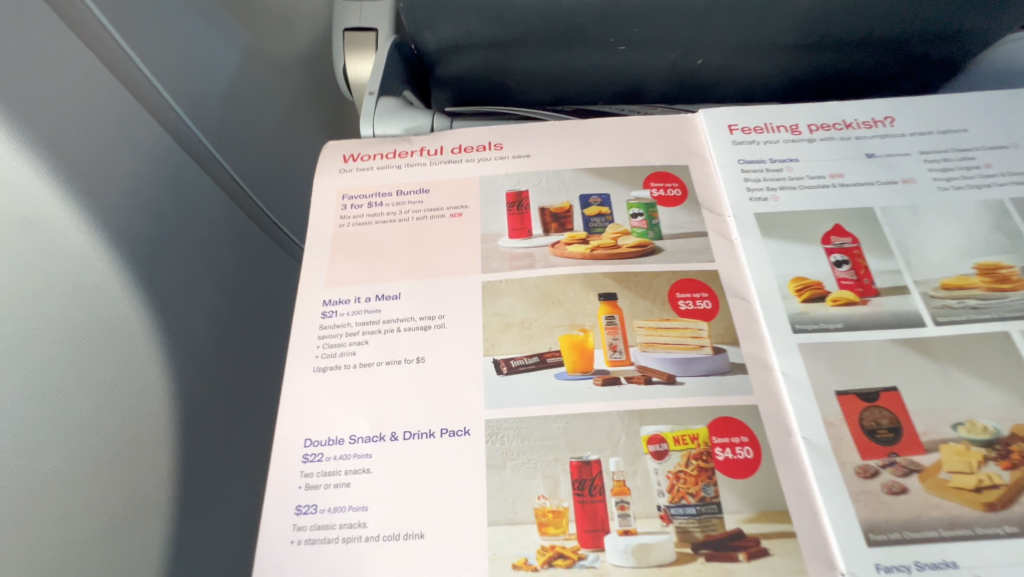
My Onboard Meal
For today’s flight I settled on what has become something of a regular order whenever I travel with Virgin Australia.
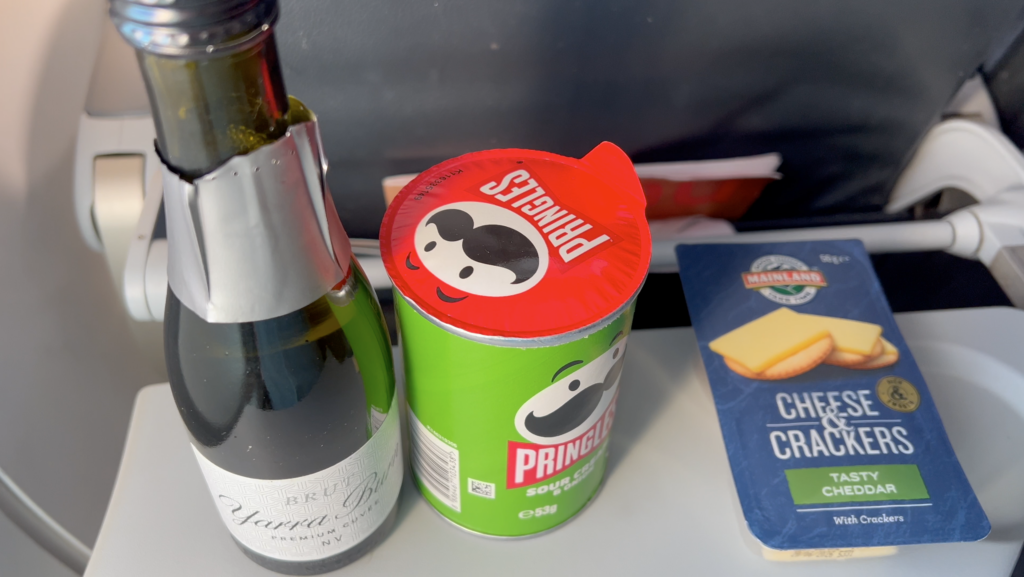
A sparkling wine, a tube of Pringles and the airline’s familiar cheese and crackers combination.
The entire purchase came to $22.
While hardly inexpensive, the combination proved filling enough for a long afternoon crossing Australia and offered a reasonable balance between value and convenience.
The sparkling wine was perfectly drinkable, even if the bottle perhaps looked slightly more premium than the contents themselves.
Meanwhile, the Pringles were exactly what you’d expect—simple, reliable and difficult to go wrong with.
The cheese and crackers remain one of Virgin Australia’s better snack offerings and are, interestingly, essentially the same product served to Business Class passengers alongside other meal components.
A Comfortable Afternoon Crossing Australia
With the on board service out of the way, the remainder of the journey settled into a relaxed rhythm.
Unlike flights affected by turbulence across the Great Dividing Range or tropical weather in northern Australia, today’s crossing proved remarkably smooth.
Outside the window stretched seemingly endless ocean before eventually giving way to the isolated southern coastline of Western Australia.
These quieter moments often allow a better appreciation of just how immense Australia truly is.
Hours can pass without seeing a major town below, highlighting the enormous distances airlines routinely connect every day across the continent.
For passengers simply wanting to relax, read, watch a movie or catch up on work, Virgin Australia’s cabin provides a calm and comfortable environment for the journey west.
Arrival into Perth
After spending more than four hours crossing the Southern Ocean and the Great Australian Bight, Western Australia finally came into view just as the afternoon sun began to sink towards the horizon. One of the highlights of flying between Hobart and Perth is that, unlike many domestic services in Australia, this route spends an extraordinary amount of time over remote wilderness and open ocean before eventually making landfall over the spectacular south coast of Western Australia.
From the right-hand side of the aircraft, passengers are treated to breathtaking views of rugged national parks, isolated beaches and endless stretches of coastline before the Boeing 737 gradually begins its descent towards Perth Airport.
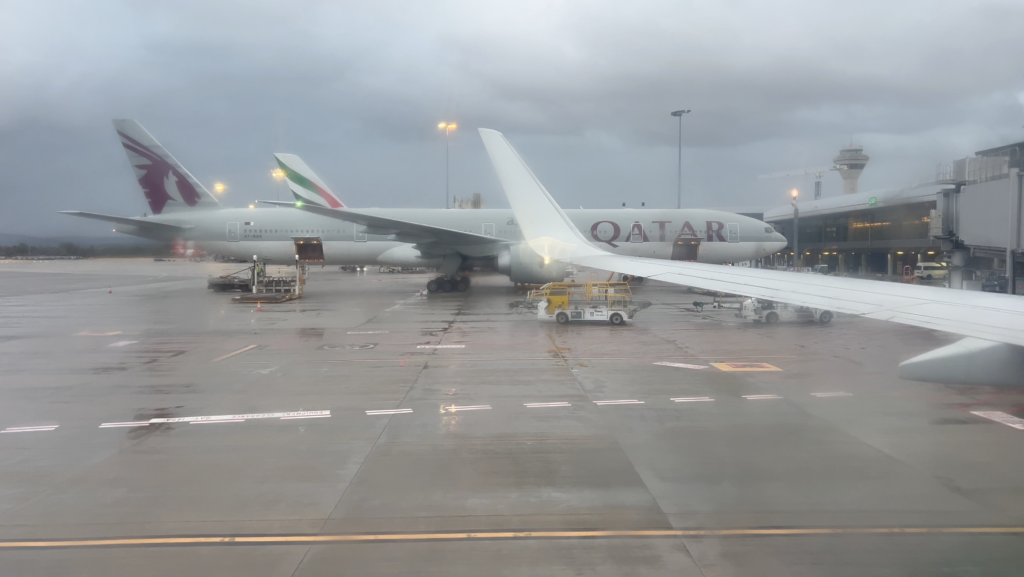
On this particular afternoon the weather over Perth was considerably cloudier than the bright conditions experienced earlier in Tasmania. Even so, the arrival remained enjoyable, with the aircraft making a smooth and professional approach before touching down gently on Perth’s main east-west runway.
Virgin Australia’s flight crew deserve considerable credit for both the departure from Hobart and the arrival into Perth. Throughout the journey the pilots kept passengers well informed with regular updates regarding weather conditions, flight time and our progress across Australia. These small touches help create a more engaging onboard experience and remain one of the strengths of Virgin Australia’s domestic operation.
Disembarkation was efficient, with passengers leaving through the forward door before making the short walk into Perth Airport’s domestic terminal. Baggage delivery was reasonably prompt, allowing the journey to conclude without any further issues.
Overall Service Review
Reflecting on the entire journey, this flight was something of a mixed experience.
Ironically, the weakest part of the trip had nothing whatsoever to do with the flight itself.
Virgin Australia’s ground handling operation at Hobart Airport fell well below what I would normally expect from one of Australia’s major airlines. Opening baggage drop only ninety minutes before departure created unnecessarily long queues and significant waiting times. While Hobart Airport itself is relatively small by Australian standards, this approach simply struggled to cope with multiple departing flights.
The check-in process ultimately took close to an hour, making it one of the least efficient domestic airport experiences I’ve encountered in Australia.
Fortunately, once onboard the experience improved dramatically.
The cabin crew were welcoming, professional and visible throughout the flight, regularly walking through the cabin and responding quickly to passenger requests. Service was delivered with genuine friendliness rather than simply following procedures, something Virgin Australia generally performs well.
The aircraft itself was clean and well presented despite now being over ten years old. While the Boeing 737-800 is beginning to show its age compared with Virgin Australia’s newer Boeing 737 MAX 8 and Embraer E190-E2 aircraft, it remains perfectly comfortable for medium and long domestic flights.
Seat comfort continues to be one of Virgin Australia’s strengths. Although the seats lack modern additions such as USB charging ports and personal entertainment screens, the padding remains noticeably more comfortable than many low-cost competitors. For a journey lasting well over four hours, that extra comfort certainly becomes appreciated.
Value for Money
One of the biggest considerations for any domestic flight within Australia is naturally price.
For this journey I paid approximately AUD $500, including checked baggage and seat selection.
Under normal circumstances I would generally consider this expensive for a domestic economy ticket.
However, context is important.
This flight was operated during the Australian summer school holiday period, one of the busiest travel seasons of the year. In addition, nonstop flights between Tasmania and Perth remain relatively limited compared with services operating between Australia’s eastern capitals.
Alternative itineraries involving connections often required significantly longer travel times while Qantas was charging considerably higher fares on the same date.
When viewed in that context, the fare represented acceptable value.
The convenience of flying nonstop across Australia saved several hours compared with connecting via Melbourne, Sydney or Adelaide, making the additional cost worthwhile.
Is Australia’s Most Southerly Domestic Flight Worth Flying?
Absolutely.
Beyond simply transporting passengers between Tasmania and Western Australia, this route offers one of the most unique domestic flying experiences available anywhere in Australia.
Few flights combine spectacular coastal scenery, remote wilderness, extended ocean crossings and almost five hours of continuous flying quite like Virgin Australia’s Hobart to Perth service.
For aviation enthusiasts, window seat lovers and anyone wanting to experience one of Australia’s most distinctive domestic routes, this flight deserves a place on your travel list.
Final Thoughts
Virgin Australia’s Hobart to Perth service is far more than simply another domestic flight.
Connecting Australia’s island state directly with the nation’s largest state by area, it represents one of the country’s longest, most scenic and most unique domestic routes. Flying over Tasmania’s rugged wilderness before crossing thousands of kilometres of the Great Australian Bight creates an experience unlike almost any other domestic journey.
If Virgin Australia can improve its ground operations at Hobart Airport, this service would be very difficult to fault.
For anyone considering travelling between Tasmania and Western Australia, particularly those wanting to avoid lengthy connections through Melbourne or Sydney, I would have little hesitation recommending this flight.
It may be Australia’s most southerly domestic route, but it is also one of its most memorable.
Disclaimer: This article has been repurposed from the original transcript of my own flight review on the Aussie JetSetter Youtube channel with the assistance of AI technologies. Please be advised whilst I have taken the utmost care to review and revise this article where necessary to reflect the upmost of accuracy at time of publication please be advised my reviews whether written or in video form are for entertainment and general information purposes only. They reflect the objective views in good faith of the person only whom is presenting them unless otherwise noted. Any decisions you make resulting from consuming my content must take into consideration your own circumstances, research and responsibility as I can not be hold responsible for any inaccuracies or future changes effecting the relativity of such reviews. All Rights Reserved by Aussie JetSetter from 2022 >