




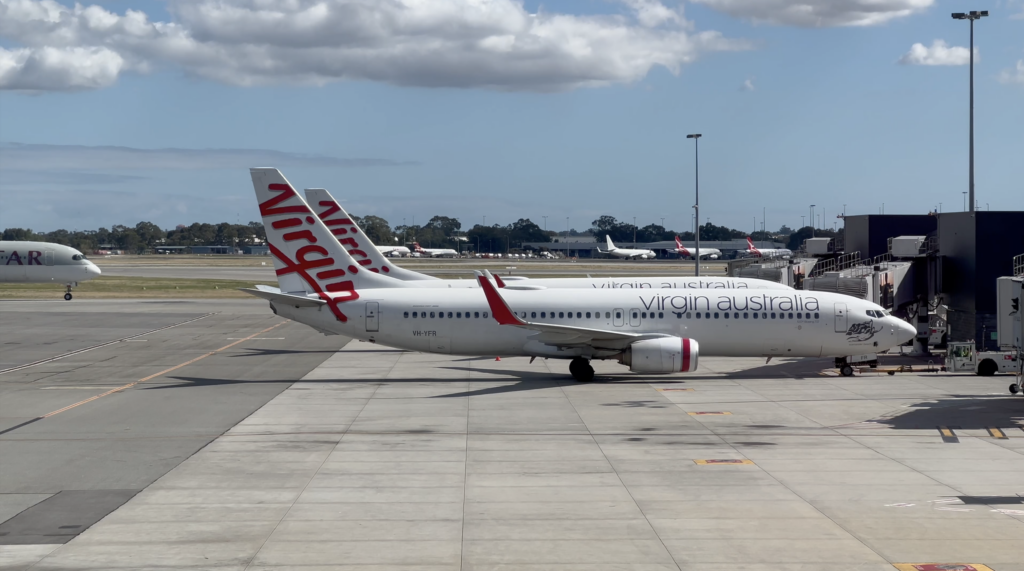
For many Australian travellers, the four-hour journey between Perth and Sydney is one of the country’s most important domestic routes. Stretching more than 3,200 kilometres across the Australian continent, it’s a flight long enough that comfort begins to matter. While economy is perfectly adequate for many travellers, the temptation to upgrade into business class can be difficult to resist—particularly if Virgin Australia offers one of its popular UpgradeMe bidding opportunities.
That was exactly the situation on this trip.
Having already secured a complimentary return flight through an American Express Velocity Platinum credit card benefit, I decided to take a chance and submit a business class upgrade bid. Rather than bidding aggressively, I added just $10 above the minimum amount required.
To my surprise, it cleared.
Instead of spending four hours in economy, I would be reviewing Virgin Australia’s domestic Business Class product on board one of its Boeing 737-800 aircraft—a product that has become increasingly important as Virgin Australia focuses almost exclusively on domestic and short-haul international flying.
So, is Virgin Australia’s Business Class actually worth it?
Can the airline compete with Qantas on Australia’s premium domestic routes?
And perhaps most importantly, is it worth paying full price—or is it only worthwhile if you can score an upgrade?
After experiencing every part of the journey, from Perth Airport’s Virgin Australia Lounge through to arrival into Sydney, here’s my detailed review.
Beginning the Journey at Perth Airport
Every great flight review begins long before boarding, and this particular trip was no exception.
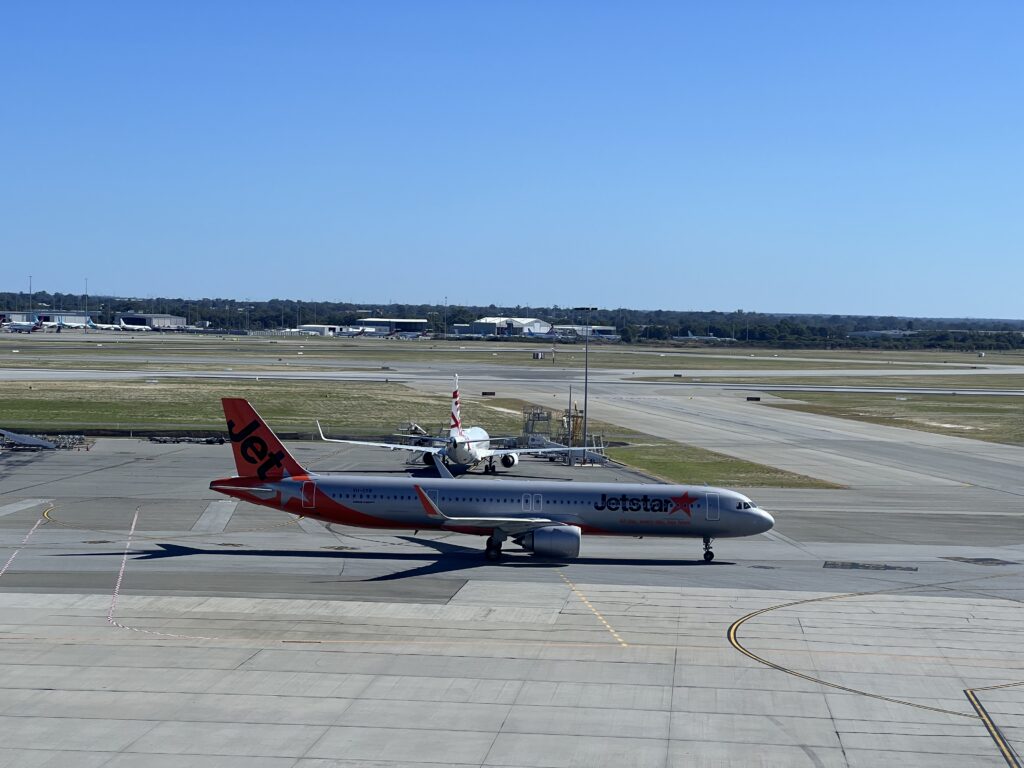
Rather than heading straight to check-in, I spent several hours enjoying one of Perth Airport’s hidden gems—the indoor public viewing deck overlooking Terminal 1 International.
Unlike many airports around Australia that have gradually removed dedicated public viewing facilities, Perth continues to offer aviation enthusiasts an excellent place to watch aircraft movements without needing to pass through security. The viewing area provides excellent sightlines across the apron and remains one of Australia’s best plane spotting locations.
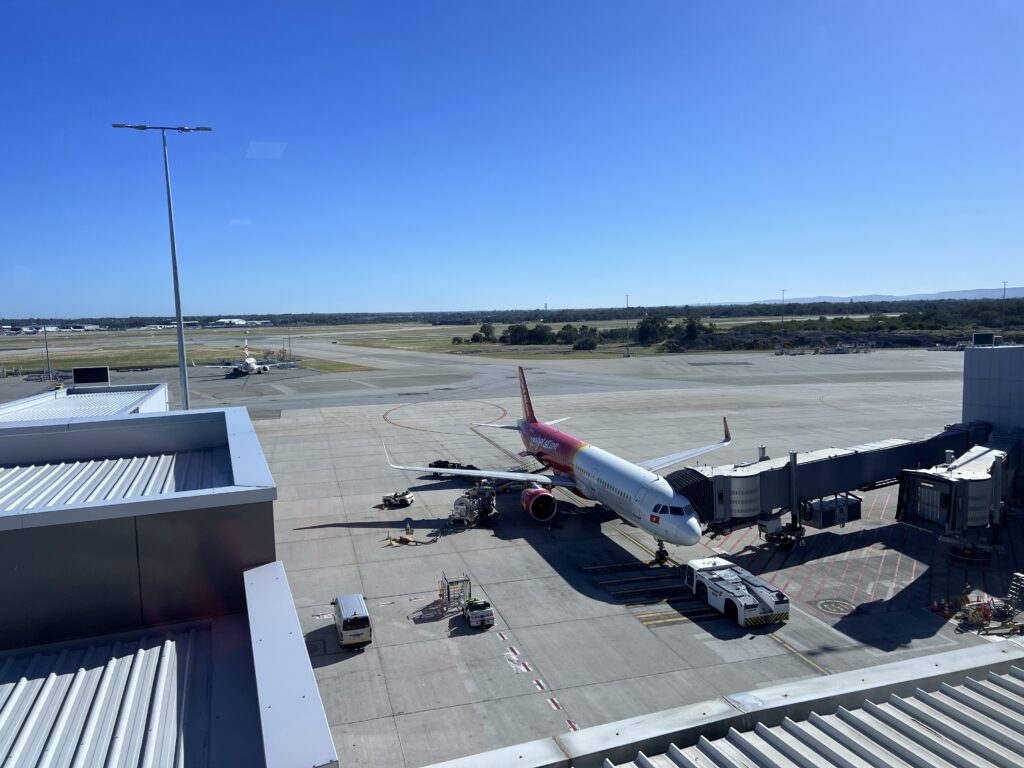
It was an especially enjoyable afternoon because I was joined by several fellow aviation enthusiasts during my second community meetup. Spending a few hours photographing aircraft and chatting about aviation made the wait for departure pass remarkably quickly before it was eventually time to make the short walk across to Virgin Australia’s domestic terminal.
The timing also added a little extra significance to the trip.
This flight departed on Anzac Day, one of Australia’s most important national commemorations, creating a noticeably calmer atmosphere around the airport compared with a typical public holiday afternoon.
A Flight That Cost Almost Nothing
One of the most interesting aspects of this review wasn’t actually the flight itself—it was how it was booked.
Instead of paying cash for the airfare, this Perth to Sydney return journey was included as an annual complimentary flight benefit through my American Express Velocity Platinum credit card.
Considering fares between Perth and Sydney regularly exceed several hundred dollars each way, this benefit alone can recover much of the annual card fee for travellers who fly regularly.
Of course, the card itself isn’t inexpensive.
With an annual fee of $440, it certainly isn’t suited to occasional travellers.
However, once lounge access, complimentary travel insurance, Velocity Points earning potential and the annual return flight are factored in, frequent domestic travellers can potentially extract considerably more value than the yearly cost.
For me, this trip demonstrated exactly why premium travel credit cards can make financial sense when used strategically.
The airfare itself was effectively covered.
That left only one additional decision to make.
Should I gamble on an upgrade?
Winning the Upgrade Bid
Virgin Australia’s UpgradeMe bidding system has become one of the airline’s most attractive features for frequent travellers.
Rather than paying the often eye-watering difference between economy and business class fares, eligible passengers can submit an offer and simply wait to see whether it clears before departure.
It’s never guaranteed.
Sometimes you’ll miss out.
Sometimes you’ll need to bid relatively high.
On this occasion, however, I decided to take a conservative approach.
Instead of bidding anywhere near the suggested “strong chance” range, I submitted an offer only $10 above the minimum acceptable amount.
Against the odds, it worked.
Receiving confirmation that the upgrade had been successful immediately transformed what would have been a fairly routine domestic journey into something much more interesting.
Considering the modest additional cost, it already felt like excellent value before even reaching the airport.
That value proposition would become a recurring theme throughout the flight.
Virgin Australia Check-in at Perth Airport
I had actually checked in several hours before departure ahead of the aviation meetup, taking advantage of Virgin Australia’s willingness to process baggage earlier than the official check-in window.
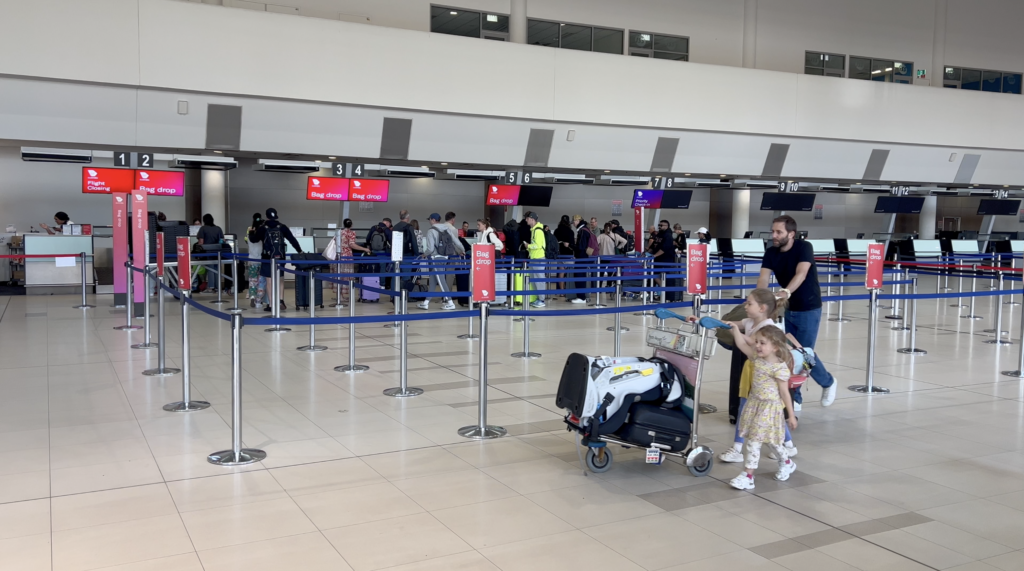
At the time of travel, however, Perth Airport’s Virgin Australia check-in area was undergoing renovation works.
Normally, passengers can expect a largely automated experience with self-service baggage drop facilities.
Temporary construction had altered that process slightly.
Passengers were still able to use the self-service kiosks to print baggage tags, but instead of dropping bags automatically, everyone needed to join a staffed counter queue.
Thankfully, it proved to be little more than a minor inconvenience.
The terminal was relatively quiet, and within only a few minutes my bag had been accepted and I was free to head towards security screening.
Considering the temporary nature of the renovations, it’s difficult to criticise Virgin Australia too heavily here.
Once construction is complete, Perth should once again offer one of the smoother domestic check-in experiences in Australia.
Security screening itself was equally painless.
With very little queueing, I was through within minutes and officially airside.
The next stop would prove to be one of the biggest advantages of flying Virgin Australia Business Class.
The Virgin Australia Lounge.
Virgin Australia Lounge Perth Review
Located immediately after clearing security in Terminal 1 Domestic, the Virgin Australia Lounge enjoys one of the most convenient locations of any airline lounge in Australia.
Unlike some airports where lounge access involves lengthy walks through the terminal, Perth’s lounge is positioned only moments from the security checkpoint.
Its entrance is impossible to miss.
Although Business Class passengers receive complimentary access as part of their ticket, this visit also highlighted another useful benefit of holding the American Express Velocity Platinum credit card, which provides unlimited entry whenever travelling on an eligible Virgin Australia flight.
For travellers who regularly fly Virgin, that benefit alone can quickly become one of the card’s biggest selling points.
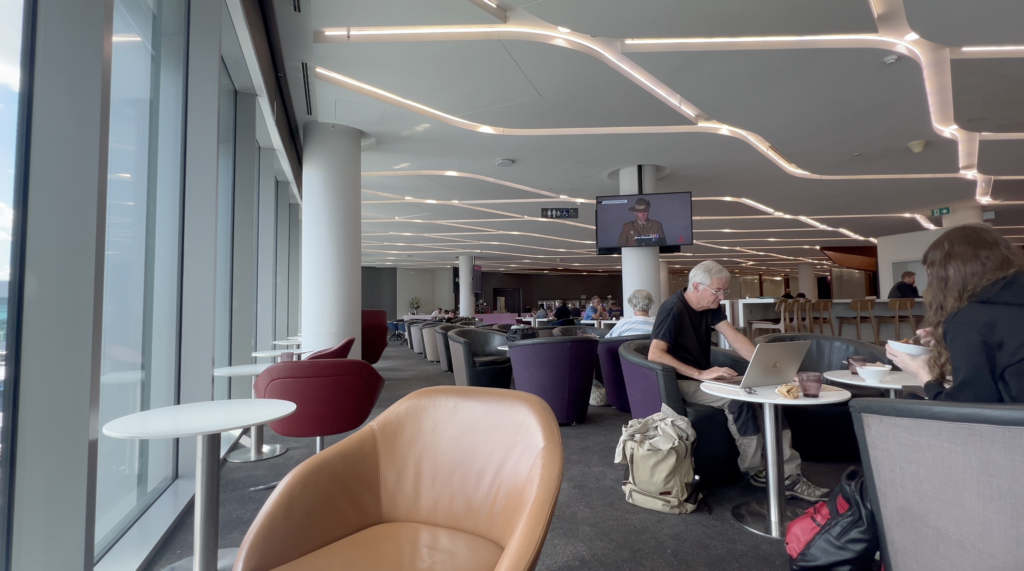
Stepping inside, the lounge immediately feels familiar.
Virgin Australia has maintained a remarkably consistent design language across its domestic lounge network.
If you’ve visited the airline’s lounges in Brisbane, Melbourne or Sydney, you’ll immediately recognise the same contemporary styling, warm lighting, varied seating arrangements and relaxed atmosphere.
What differentiates Perth, however, is the sense of space.
Because Perth isn’t handling the same constant volume of departures seen on the East Coast, the lounge rarely feels overcrowded.
Finding a comfortable seat is usually straightforward, and there’s enough room to spread out whether you’re looking to work, relax or simply enjoy lunch before your flight.
Large windows overlooking the apron also provide excellent opportunities for aircraft enthusiasts.
Watching Virgin Australia’s Boeing 737 fleet arrive and depart while enjoying lunch certainly beats staring at a terminal wall.
For aviation lovers, it’s a pleasant bonus that’s often overlooked.
Virgin Australia Lounge Perth: Food and Beverage
One of the biggest advantages of flying Business Class on Virgin Australia is arriving at the airport early enough to actually enjoy the lounge. Too many travellers walk in just before boarding, grab a quick coffee and head straight to the gate. On a journey as long as Perth to Sydney, however, the lounge forms an important part of the overall premium experience.
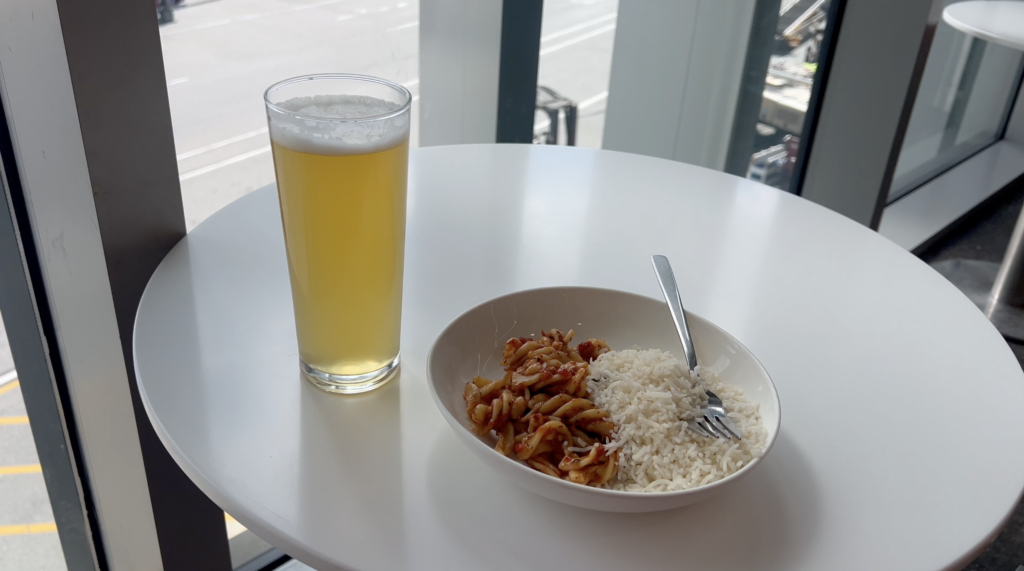
Virgin Australia’s Perth Lounge offers a respectable self-service buffet that strikes a balance between light snacks and more substantial meals. While it doesn’t aim to compete with the extensive dining found in international business class lounges, there’s certainly enough variety to satisfy most domestic travellers before boarding.
On the day of my flight, the hot food selection included butter chicken alongside a pasta dish, complemented by salads, pastries, cheeses, crackers and various lighter options. It isn’t restaurant-quality dining, but it’s comfortably above what most passengers would otherwise purchase in the terminal food court.
The standout dish was undoubtedly the butter chicken.
Rich, flavoursome and surprisingly tender, it was genuinely enjoyable and easily the highlight of the buffet. The remainder of the selection was solid without being particularly memorable, but everything was fresh and well presented.
Coffee lovers are equally well catered for.
Unlike many airport lounges that rely solely on self-service coffee machines, Virgin Australia continues to provide barista-made coffee throughout the day—a small detail that significantly improves the premium experience.
For those preferring something stronger, a fully serviced bar operates from midday.
Because this particular flight departed on Anzac Day, however, Western Australia’s special liquor licensing laws required alcoholic beverages to be served only alongside a meal before 1:00 pm. As a result, I found myself returning for a second helping of lunch—not that I was complaining.
By the time I finished eating, I was comfortably full.
In hindsight, perhaps a little too full considering a Business Class meal was still waiting on board.
Nevertheless, it was difficult to fault the lounge catering. While Virgin Australia’s domestic lounges won’t rival premium international facilities in Singapore, Doha or Dubai, they consistently provide a pleasant environment to relax before departure, and Perth’s lounge is no exception.
Watching Our Aircraft Arrive
One of my favourite aspects of Perth’s Virgin Australia Lounge is its excellent apron views.
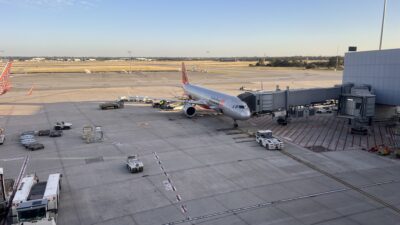
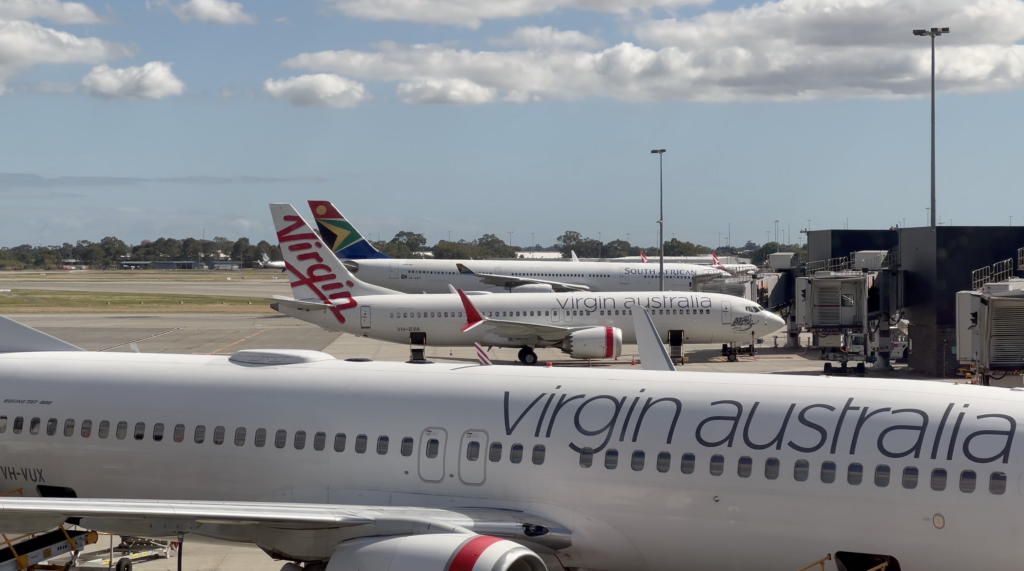
As boarding time gradually approached, our aircraft arrived at the gate directly outside the lounge windows, providing an ideal opportunity to take a closer look at the aircraft that would be carrying us across Australia.
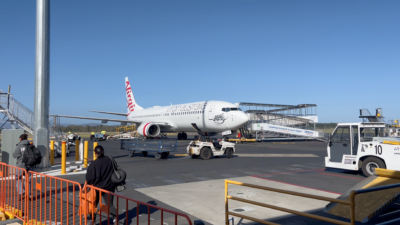
Today’s aircraft was a familiar workhorse of Virgin Australia’s domestic fleet—a Boeing 737-800 registered VH-VUX, carrying the name Nightcliff Beach. The aircraft has an interesting history that mirrors the evolution of Virgin Australia itself.
Originally delivered in September 2010 during the airline’s Virgin Blue era, it later transitioned into Virgin Australia’s colours following the company’s rebranding in 2011. For a period, it even operated under Tigerair Australia before returning to Virgin Australia’s mainline fleet following Tigerair’s closure during the airline’s restructuring.
At around fifteen and a half years old, the aircraft certainly isn’t new.
However, like much of Virgin Australia’s Boeing 737 fleet, it has been carefully maintained and continues to perform the airline’s most important domestic routes reliably.
Although newer aircraft naturally attract more attention, there’s something reassuring about flying aboard an aircraft that has spent well over a decade connecting Australians across one of the world’s largest countries.
Boarding the Flight
Before long, boarding was called precisely on schedule.
One advantage of travelling in Business Class is access to priority boarding, allowing passengers to board ahead of the main economy queues. That said, I’ve always preferred making the most of lounge access rather than standing on the aerobridge waiting to board first.
Fortunately, Virgin Australia’s boarding process is flexible enough that Business Class passengers can still use the priority lane even after general boarding has commenced.
Our departure gate was conveniently located only a minute or two from the lounge entrance, making the transition from lounge chair to aircraft seat remarkably easy.
Ground staff processed boarding efficiently, and within moments I was stepping through the aircraft door and into Virgin Australia’s premium cabin.
First Impressions of the Cabin
Unlike widebody aircraft featuring expansive premium cabins, Virgin Australia’s Boeing 737 Business Class feels intimate.
The cabin consists of just eight leather recliner seats arranged in a traditional 2-2 configuration across the first two rows of the aircraft.
While relatively small, that exclusivity contributes significantly to the overall atmosphere.
With only a handful of passengers to look after, the cabin feels calm from the moment you step aboard. There’s no rush, no crowding in the aisle and none of the frantic scramble for overhead locker space that often accompanies economy boarding.
The welcome from the cabin crew was warm and genuine.
One aspect Virgin Australia consistently does well is customer service, and that friendly Australian hospitality was immediately apparent as I was shown to Seat 1A—the bulkhead window seat on the left-hand side.
For a daytime flight, it was an excellent choice.
Virgin Australia Boeing 737 Business Class Seat
Virgin Australia’s Business Class seat is best described as practical rather than revolutionary.
Anyone expecting fully flat beds similar to those found on Qantas’ Airbus A330 or Boeing 787 services across Australia should temper their expectations.
Instead, Virgin Australia offers a premium recliner designed specifically for domestic flying.
That doesn’t necessarily make it disappointing.
Far from it.
The leather seats remain attractive, well padded and significantly more spacious than Economy Class. With approximately 38 inches of seat pitch, there’s ample room to stretch out throughout the four-hour journey, particularly compared to the far tighter seating further back in the aircraft.
The bulkhead position also enhanced the feeling of space, with unrestricted legroom directly ahead.
Storage options are sensible, if somewhat limited.
A small side compartment provides enough room for smaller personal items, while both AC power and USB charging ports are conveniently positioned beside the seat, ensuring laptops, tablets and phones remain fully charged throughout the flight.
Seat controls are simple and intuitive, allowing passengers to adjust recline and deploy the extendable footrest with ease.
One feature I particularly appreciate is Virgin Australia’s sturdy tray table.
Rather than folding down from the seat in front, it slides neatly from the armrest and can be adjusted into several positions, making it equally suitable for working on a laptop or enjoying the meal service.
Between each pair of seats sits a small cocktail table, providing a convenient place to rest a drink without occupying the larger dining table—a surprisingly useful feature during the cruise.
Overall, while these seats won’t generate the same excitement as a lie-flat suite, they remain perfectly comfortable for domestic flights of this duration.
The important question, however, is whether they’re worth paying a full Business Class fare for.
That answer would become clearer later in the journey.
Pre-Departure Service
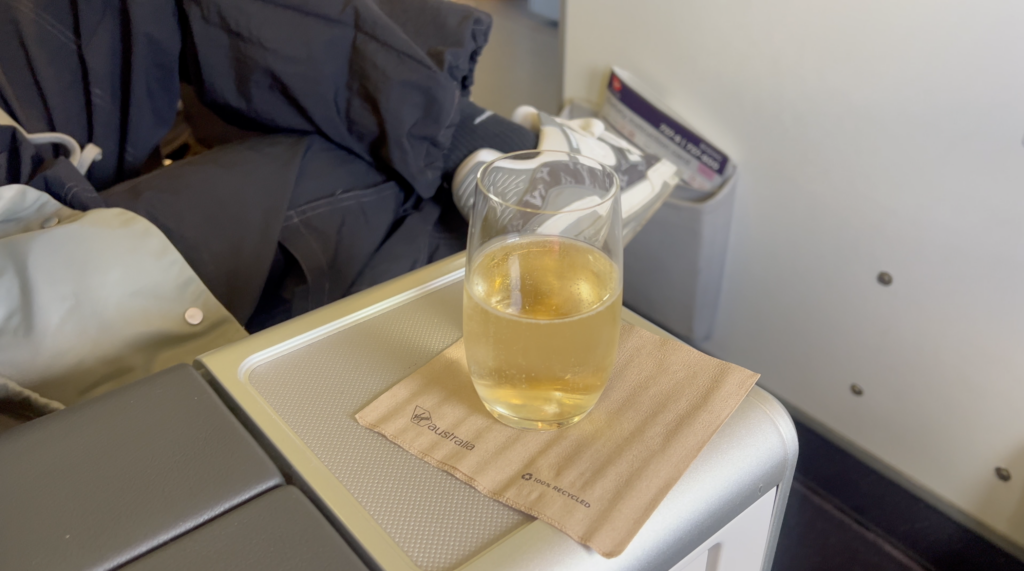
Before departure, the crew began offering pre-departure beverages—a hallmark of any premium cabin experience.
Passengers could choose between sparkling wine, orange juice or water, all served promptly while boarding continued.
Although seemingly a small touch, pre-departure drinks immediately distinguish Business Class from Economy and help establish a more relaxed atmosphere before pushback.
Within minutes, boarding was complete.
The aircraft doors closed precisely on schedule, the safety demonstration concluded, and our Boeing 737 slowly pushed back from the gate before beginning the short taxi towards Perth Airport’s Runway 21.
As always, there’s something uniquely satisfying about departures from Perth.
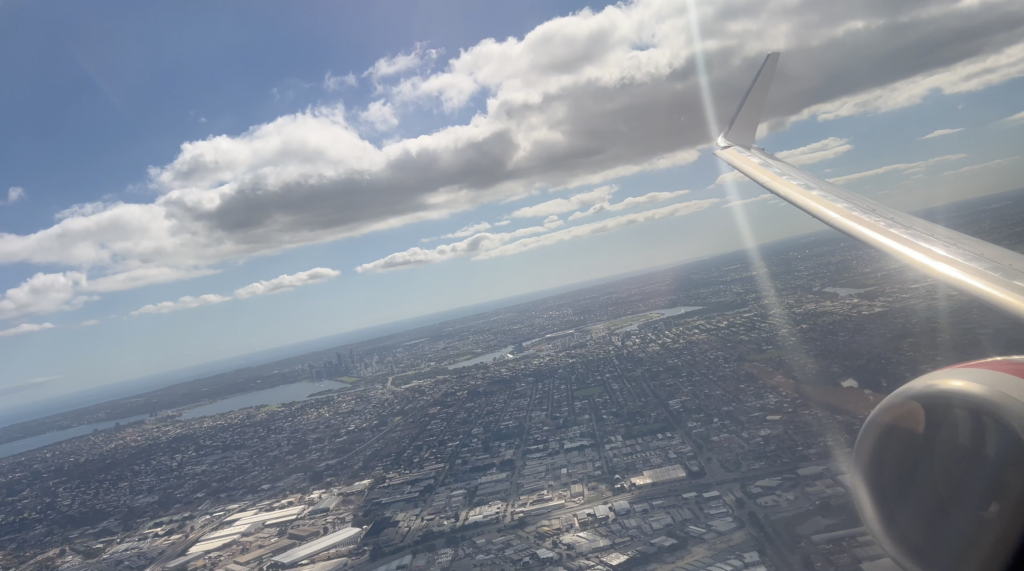
Unlike many major Australian airports, the city skyline remains visible for much of the climb, offering spectacular views as the aircraft banks eastward towards the vast Australian interior.
With engines spooling up for take-off and nearly four hours of flying ahead, it was finally time to discover whether Virgin Australia’s Business Class experience could justify the upgrade.
Virgin Australia Business Class Review: The Flight Experience
As our Boeing 737 accelerated down Runway 21, it quickly became clear why Perth remains one of Australia’s most enjoyable airports to depart from.
With relatively little surrounding terrain and unrestricted views across the metropolitan area, the initial climb provides an excellent perspective of the city below. Looking out from Seat 1A, the Perth skyline gradually shrank into the distance as we banked east, passing over the Swan River before leaving the Western Australian coastline behind.
Within only a few minutes we were climbing smoothly towards our cruising altitude of 39,000 feet, beginning the long journey across the vast Australian continent.
Unlike shorter domestic sectors between Sydney, Melbourne and Brisbane, the Perth to Sydney route offers enough time to genuinely settle into the flight. Four hours may not sound especially long by international standards, but it’s more than sufficient to evaluate every aspect of an airline’s premium product.
With the seatbelt signs extinguished and the cabin settling into cruise, it was time to explore Virgin Australia’s onboard offering.
Entertainment System: Bring Your Own Device
One area where Virgin Australia continues to differ from many international carriers is its decision to use a bring-your-own-device (BYOD) entertainment system.
Rather than installing seatback entertainment screens throughout the cabin, passengers connect their own smartphone, tablet or laptop to Virgin Australia’s wireless streaming portal.
This approach has obvious advantages for the airline.
Removing seatback screens reduces aircraft weight, lowers maintenance costs and simplifies fleet operations.
For passengers, however, opinions tend to be divided.
Personally, I’ve become quite comfortable with the concept.
Most travellers already carry multiple electronic devices, and streaming content directly to a high-resolution tablet often provides a better viewing experience than many ageing seatback screens.
Connecting was straightforward.
After joining the onboard Wi-Fi network, the entertainment portal loaded quickly and presented a broad selection of movies, television series, documentaries, children’s programming and podcasts.
Virgin Australia has invested considerably in its entertainment catalogue over recent years, and it shows.
The movie selection includes a healthy mix of recent Hollywood releases alongside older favourites, while television fans have access to numerous complete box sets that are ideal for longer domestic flights.
Navigation throughout the interface felt intuitive and responsive.
Finding content required only a few taps, with very little waiting between menus.
For most travellers, the entertainment selection should prove more than adequate for a four-hour flight.
There was, however, one omission that continues to disappoint.
Unlike Qantas, Virgin Australia still doesn’t provide a moving flight map.
For aviation enthusiasts, half the enjoyment of flying across Australia comes from watching the aircraft’s progress over the continent—tracking the route across the Nullarbor, identifying towns below and monitoring altitude, speed and outside temperature.
It’s a surprisingly engaging feature that many travellers use regularly, and its absence remains one of the few noticeable weaknesses of Virgin Australia’s otherwise solid entertainment platform.
Hopefully it’s something the airline addresses in future updates.
Complimentary Wi-Fi: One of Business Class’s Best Benefits
While the entertainment system is identical in both cabins, one significant advantage of flying Business Class is complimentary onboard Wi-Fi.
Economy passengers must purchase internet access, whereas Business Class passengers receive unlimited connectivity included in the fare.
As always, no airline review feels complete without a Wi-Fi speed test.
Connecting took only moments.
General browsing proved perfectly acceptable.
Checking emails, reading news websites and browsing social media all worked with minimal delay. Pages loaded consistently, making it entirely practical to remain productive throughout the flight.
The real challenge came when I attempted something more demanding.
Streaming live television via YouTube naturally placed greater demands on the satellite connection. Initial loading took noticeably longer, but once the stream settled, playback remained surprisingly watchable.
Buffering occurred occasionally, particularly when network demand fluctuated, but considering we were cruising nearly 12 kilometres above some of Australia’s most remote landscapes, the overall performance remained impressive.
Curious to push the system further, I also attempted to stream content through Binge.
Unfortunately, the service appeared to be geo-blocked despite still flying within Australian airspace, preventing playback altogether.
While slightly disappointing, that’s more a content licensing issue than an airline limitation.
During the remainder of the flight, the internet remained reasonably reliable, although it did occasionally disconnect and require logging back into the portal.
This proved mildly frustrating but never became a major inconvenience.
For passengers purchasing Wi-Fi in Economy, the current full-flight price sits around $19.95.
Whether that’s worthwhile depends entirely on individual priorities.
If you’re planning to work, stay connected with family or simply browse throughout a four-hour transcontinental journey, it’s probably money well spent.
For Business Class passengers, however, receiving unlimited internet access at no additional cost adds genuine value to the premium experience.
Lunch Service at 39,000 Feet
One of the highlights of any Business Class review is undoubtedly the meal service.
Unlike many domestic airlines overseas that provide only light refreshments, Virgin Australia continues to offer a proper plated meal on longer transcontinental services.
Service began shortly after reaching cruising altitude.
The cabin crew worked efficiently yet without ever making the process feel rushed.
Tables were laid individually before meals arrived neatly presented on a single tray.
Presentation was excellent.
Everything looked fresh, colourful and thoughtfully arranged.
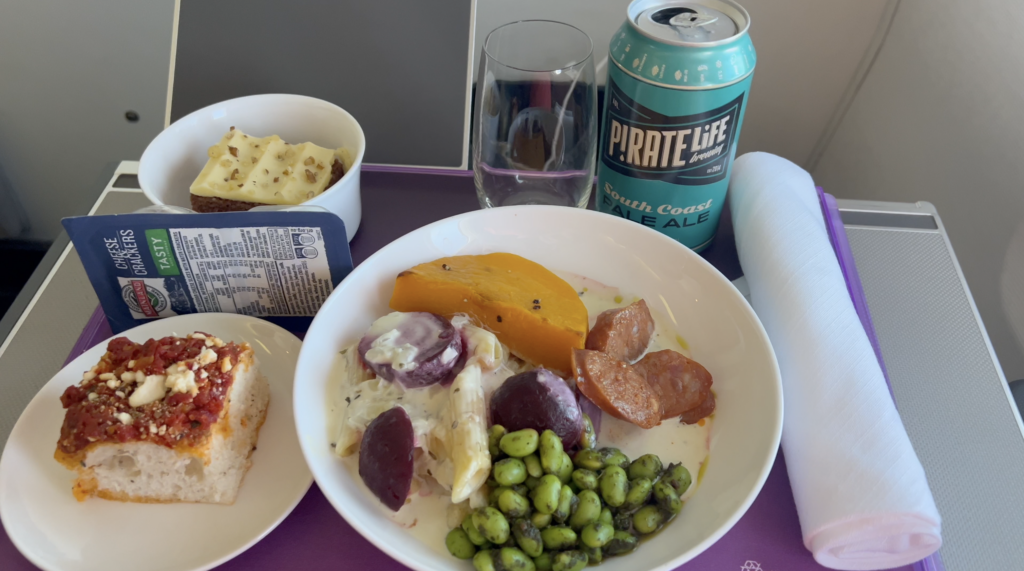
Today’s lunch consisted of:
- Creamy cheese tortellini
- Caesar salad topped with chorizo
- Roasted pumpkin
- Tomato and feta
- Meredith Dairy feta
- Artisan crackers with cheddar cheese
- White chocolate and macadamia cake for dessert
Accompanying the meal was a selection of complimentary beverages, and I opted for a Pirate Life South Coast Pale Ale, one of Australia’s increasingly popular craft beers.
From a visual perspective, the meal exceeded expectations.
It certainly looked worthy of Business Class.
Unfortunately, taste is always subjective.
While I could appreciate the quality of the ingredients and the care taken with presentation, the overall menu simply wasn’t particularly suited to my personal preferences.
The tortellini itself was perfectly cooked.
The salad remained crisp.
The dessert was pleasant without being overly sweet.
Objectively, there was very little to criticise.
It simply wasn’t the style of meal I would naturally choose.
That’s an important distinction.
Poor food and food that doesn’t suit individual tastes are two very different things.
In this case, the latter applied.
I suspect many passengers would enjoy the menu considerably more than I did.
Virgin Australia deserves credit for offering meals that feel genuinely premium rather than simply reheated airline catering.
Drinks Service Done Right
If there was one area where the cabin crew particularly impressed, it was their attentiveness throughout the remainder of the flight.
Unlike some domestic Business Class cabins where service largely concludes once trays are collected, Virgin Australia’s crew remained highly visible throughout the journey.
Glasses were regularly topped up.
Additional beverages were offered proactively.
Crew members walked through the cabin frequently without becoming intrusive.
Over the course of the afternoon, I sampled several drinks, including the Yarra Burn Sparkling, a Victorian Chardonnay and an SSBV white blend.
Each was served professionally in proper glassware rather than disposable cups, adding another small touch that reinforces the premium experience.
Later in the flight, additional snacks were also offered.
It wasn’t extravagant service by international long-haul standards, but for a domestic Australian flight it struck an excellent balance between attentiveness and allowing passengers to simply relax.
The friendliness of the crew also deserves recognition.
Every interaction felt genuine.
There was no sense of robotic service or scripted hospitality.
Instead, conversations felt naturally Australian—warm, approachable and relaxed.
It’s something Virgin Australia has long done well, and this flight continued that reputation.
Crossing Australia
Once lunch concluded, the cabin settled into the quieter rhythm that defines long domestic flights across Australia.
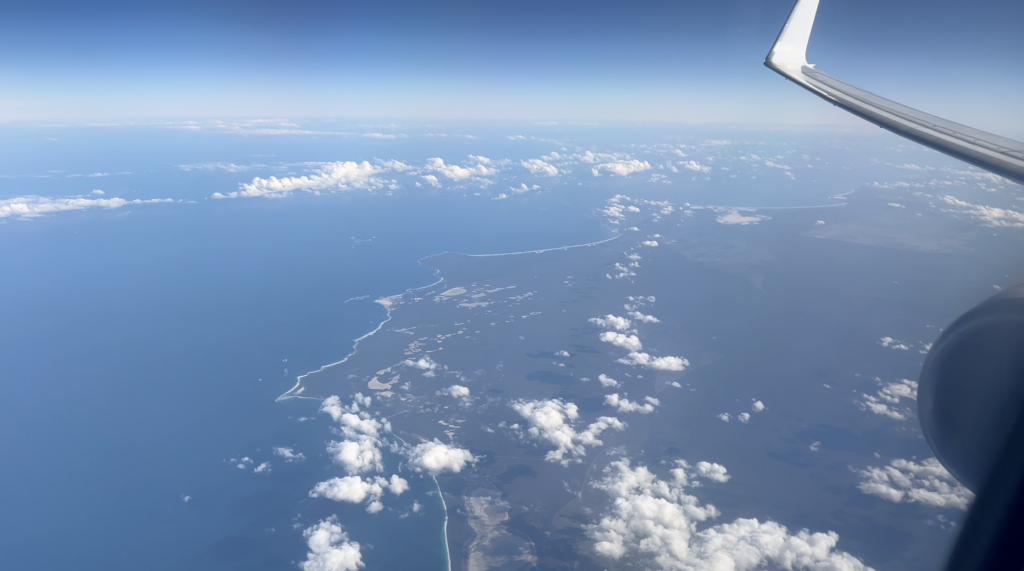
Outside the window, Western Australia’s coastline gradually disappeared behind us as we crossed Israelite Bay before heading out over the immense emptiness of the Nullarbor Plain.
There’s something uniquely captivating about this route.
Unlike flights along Australia’s populated eastern seaboard, much of the journey passes over landscapes where signs of civilisation become increasingly rare.
Endless stretches of red earth, salt lakes and sparse vegetation slowly drift beneath the aircraft, providing a fascinating reminder of Australia’s extraordinary scale.
Weather conditions throughout the afternoon were almost ideal.
Visibility remained excellent across much of Western Australia, allowing uninterrupted views of the coastline before eventually crossing into South Australia.
With the meal finished and drinks flowing, the remainder of the cruise became wonderfully relaxing.
I alternated between watching downloaded content on my iPad, browsing the internet using the complimentary Wi-Fi and simply enjoying the peaceful atmosphere inside the small eight-seat Business Class cabin.
It’s during moments like these that Business Class begins to justify itself.
Not because of any single luxury.
Rather, it’s the combination of additional personal space, quieter surroundings, attentive service and the ability to genuinely unwind that transforms what could otherwise feel like a long domestic flight into an enjoyable afternoon.
Business Class Lavatory
Before beginning our descent, there was one final aspect left to inspect—the forward Business Class lavatory.
Realistically, expectations should remain modest.
Unlike widebody international aircraft featuring spacious premium washrooms, the Boeing 737 offers only the standard narrow-body lavatory.
Virgin Australia reserves the forward facility exclusively for Business Class passengers, helping keep it noticeably cleaner throughout the flight.
Inside, everything was spotless.
Surfaces remained clean, amenities were fully stocked and the overall presentation reflected the professionalism of the cabin crew.
There are no premium features such as upgraded toiletries or larger changing areas.
In fact, the layout is virtually identical to the economy lavatories located further aft.
Nevertheless, exclusivity alone makes a noticeable difference.
With only eight passengers sharing the facility, queues simply never develop.
Sometimes, convenience is luxury enough.
Arriving into Sydney
After more than four hours crossing the Australian continent, the cabin lights were gradually brightened as the captain announced our initial descent into Sydney.
By this stage of the journey, daylight had faded and darkness had settled across much of southeastern Australia. While the cloud cover unfortunately obscured what might otherwise have been spectacular evening views over Adelaide during the latter stages of the flight, the anticipation of arriving into Australia’s largest city remained.
For aviation enthusiasts, there’s something special about approaching Sydney Kingsford Smith Airport after crossing almost the entire width of the continent. It’s one of the world’s great domestic journeys, linking two cities separated by nearly 3,300 kilometres and several time zones, yet completed in just over four hours.
As the aircraft descended through the evening sky, the familiar lights of suburban Sydney gradually came into view before lining up for the final approach into Kingsford Smith.
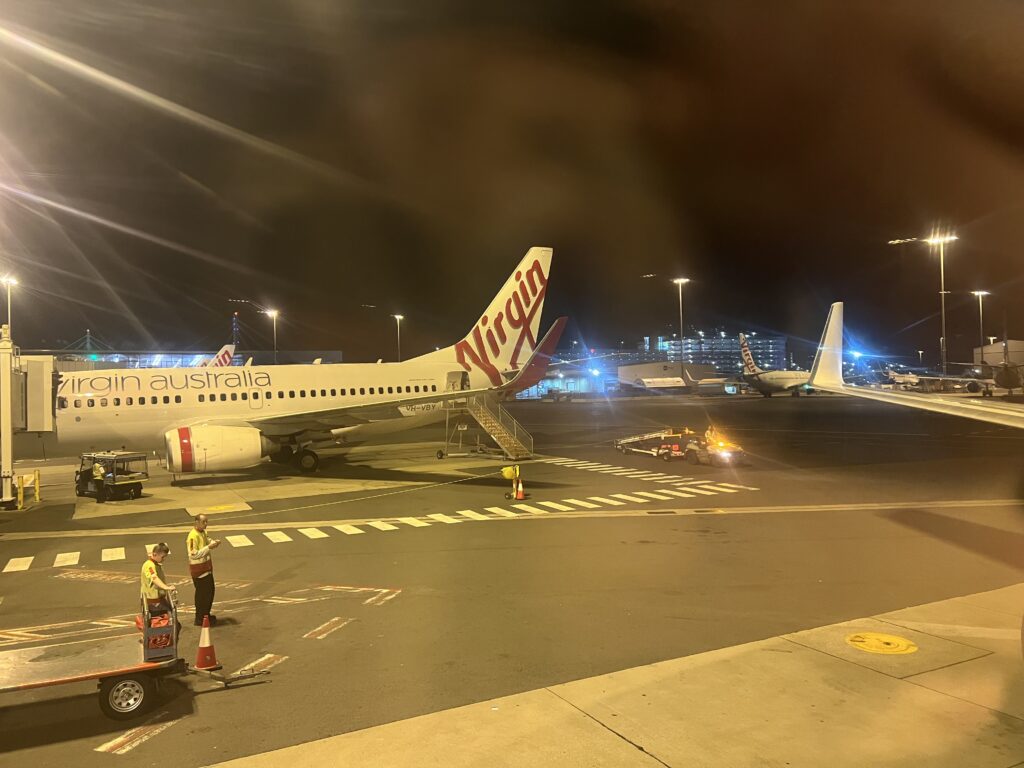
The landing itself was smooth, followed by a short taxi to the gate.
Perhaps most impressively, the flight had remained perfectly on schedule throughout the day.
In an era where delays have become increasingly common across aviation, punctuality shouldn’t be overlooked. Virgin Australia delivered exactly what was promised—a comfortable transcontinental journey departing on time and arriving on time.
For both business travellers and holidaymakers alike, reliability remains one of the airline’s greatest strengths.
Final Thoughts on the Virgin Australia Business Class Experience
Stepping off the aircraft, I found myself reflecting on an important question:
Would I fly Virgin Australia Business Class again?
The answer is an easy yes.
However, there is an important caveat.
I wouldn’t necessarily pay full fare.
That distinction ultimately defines Virgin Australia’s Business Class product.
Check-in and Ground Experience
The journey began positively.
Despite temporary renovation works affecting Perth Airport’s check-in area, the process remained quick and efficient. Staff were friendly, queues were minimal and baggage was processed within only a few minutes.
Security screening proved equally straightforward before leading directly into one of Virgin Australia’s better domestic lounges.
The Perth Lounge may not compete with international premium lounges, but it comfortably delivers everything most domestic travellers need.
Comfortable seating.
Quality coffee.
Good runway views.
A respectable buffet.
Friendly staff.
For a domestic departure, it’s a pleasant environment in which to begin a journey.
Cabin Crew: The Standout Feature
If there was one aspect of today’s experience that consistently exceeded expectations, it was the service.
Virgin Australia’s cabin crew were exceptional.
Professional without feeling formal.
Friendly without becoming intrusive.
Attentive without hovering.
Throughout the flight they regularly walked the cabin offering drink refills, checking whether passengers required anything further and ensuring everyone remained comfortable.
It’s an area where Virgin Australia has built an excellent reputation over many years, and this flight demonstrated exactly why.
Premium cabins aren’t defined solely by larger seats.
They’re defined by service.
Today’s crew understood that perfectly.
Food and Beverage
The onboard catering was another area that deserves recognition.
Although the lunch menu itself wasn’t particularly suited to my personal tastes, the presentation was excellent and the overall quality of ingredients appeared noticeably above average for Australian domestic flying.
It’s important to separate objective quality from subjective preference.
Had the menu featured dishes more aligned with my own tastes, I suspect I’d have rated it considerably higher.
The beverage selection also impressed.
Virgin Australia’s inclusion of Australian wines and locally produced craft beer helps create a distinctly Australian premium experience rather than simply serving generic international brands.
Seat Comfort
The seat itself represents both the biggest strength and the biggest weakness of Virgin Australia’s Business Class.
On one hand, it’s spacious.
Comfortable.
Well padded.
Equipped with power outlets.
Easy to recline.
Ideal for working or relaxing over several hours.
On the other hand, it’s still fundamentally a recliner seat.
For flights approaching four or five hours, that inevitably limits the premium experience.
Travellers accustomed to international Business Class—or even Qantas’ Airbus A330 and Boeing 787 domestic services—will naturally find Virgin Australia’s Boeing 737 cabin less impressive.
That’s simply the reality of operating narrow-body aircraft.
The seat isn’t bad.
Far from it.
It’s just not revolutionary.
Entertainment and Wi-Fi
Virgin Australia’s streaming entertainment platform continues to improve each year.
The content library is extensive, navigation is intuitive and streaming quality remains consistently good.
The complimentary Business Class Wi-Fi also exceeded expectations.
While not fast enough to replace home broadband, it comfortably handled browsing, email and even moderate video streaming for much of the flight.
The only notable disappointment remains the lack of a moving flight map.
For many travellers that omission won’t matter.
For aviation enthusiasts, however, it’s a feature I’d genuinely love to see added.
Is Virgin Australia Business Class Worth It?
This is ultimately the question most travellers want answered.
The answer depends almost entirely on how much you pay.
If you secure an upgrade bid…
Absolutely.
Without hesitation.
Today’s successful upgrade cost only $135, barely more than the price difference to Economy X.
At that level, the value becomes exceptional.
You receive:
- Priority boarding
- Lounge access
- Larger leather seat
- Complimentary drinks
- Full meal service
- Complimentary Wi-Fi
- Extra baggage allowance
- Dedicated Business Class cabin
- Outstanding service
For approximately the cost of dinner at a restaurant, that’s excellent value on a four-hour flight.
If paying full fare…
My opinion changes considerably.
On the day of travel, Business Class was selling for approximately $1,500 one-way.
Personally, I simply couldn’t justify that premium.
Not when Qantas frequently operates Airbus A330s and Boeing 787s on competing routes featuring fully flat beds.
If I’m spending well over a thousand dollars on a domestic flight, I expect considerably more than a recliner.
Virgin Australia’s pricing occasionally pushes its Business Class into a category where the hard product simply struggles to compete.
Virgin Australia vs Qantas Business Class
For travellers specifically choosing between Australia’s two major full-service airlines, the comparison is relatively straightforward.
Virgin Australia wins in several important areas:
- Friendlier cabin service
- Excellent value through upgrade bids
- Complimentary Business Class Wi-Fi
- Relaxed onboard atmosphere
- Consistently good lounge experience
Qantas, however, retains a significant advantage whenever it operates widebody aircraft.
Its Airbus A330 and Boeing 787 Business Suites provide:
- Fully flat beds
- Greater privacy
- Superior sleeping comfort
- Larger entertainment screens
- A more premium overall hard product
If both airlines are operating Boeing 737s, the competition becomes much closer.
If Qantas is operating an A330 or 787, however, I’d choose Qantas every time—assuming similar pricing.
Pros
✅ Excellent cabin crew and personalised service
✅ Comfortable leather recliner seats
✅ Complimentary Wi-Fi included
✅ Quality lounge access
✅ Good beverage selection
✅ Reliable on-time performance
✅ Great value through upgrade bids
Cons
❌ Recliner seats rather than lie-flat beds
❌ No seatback entertainment screens
❌ No moving flight map
❌ Full Business Class fares can be difficult to justify
❌ Meal quality will depend heavily on the menu offered that day
| Category | Rating |
|---|---|
| Check-in | ★★★★☆ (4/5) |
| Perth Lounge | ★★★★☆ (4/5) |
| Boarding | ★★★★★ (5/5) |
| Seat Comfort | ★★★★☆ (4/5) |
| Food & Beverage | ★★★☆☆ (3/5) |
| Entertainment | ★★★★☆ (4/5) |
| Wi-Fi | ★★★★☆ (4/5) |
| Cabin Crew | ★★★★★ (5/5) |
| Value (Upgrade Bid) | ★★★★★ (5/5) |
| Value (Full Fare) | ★★☆☆☆ (2/5) |
Overall Rating
⭐⭐⭐⭐☆ (4/5)
Frequently Asked Questions
Is Virgin Australia Business Class worth it from Perth to Sydney?
Yes—particularly if you secure an UpgradeMe bid. The combination of lounge access, a spacious recliner seat, complimentary Wi-Fi, premium dining and attentive service represents excellent value when purchased as an upgrade.
Does Virgin Australia Business Class include lounge access?
Yes. Business Class passengers receive complimentary access to eligible Virgin Australia lounges before departure.
Does Virgin Australia Business Class include Wi-Fi?
Yes. Complimentary Wi-Fi is included for Business Class passengers, while Economy passengers can purchase internet access during the flight.
Are Virgin Australia Business Class seats lie-flat?
No. Virgin Australia’s Boeing 737-800 fleet features premium leather recliner seats rather than fully flat beds.
Is the Perth to Sydney route long enough to justify Business Class?
For many travellers, yes. At just over four hours, the additional space, meal service and lounge access make Business Class noticeably more comfortable than Economy—particularly when available via an affordable upgrade bid.
Final Verdict
Virgin Australia has refined its domestic Business Class product into one of the most consistently enjoyable premium experiences in Australia—not because it offers the most luxurious seat, but because it gets the fundamentals right.
From an efficient ground experience and welcoming lounge to genuinely attentive cabin crew, reliable Wi-Fi and a comfortable eight-seat cabin, the airline delivers a polished product that feels designed around the needs of domestic travellers rather than unnecessary extravagance.
The biggest limitation remains the Boeing 737 itself. No matter how comfortable the recliner, it cannot compete with the lie-flat suites offered by Qantas on selected Airbus A330 and Boeing 787 services. If you’re paying a premium fare and have the option of a widebody aircraft, Qantas remains the stronger choice.
However, that’s only part of the story.
Virgin Australia’s real strength lies in value. The airline’s UpgradeMe bidding system continues to offer one of the smartest ways to experience Business Class in Australia. In this case, a modest $135 upgrade transformed what would have been an ordinary economy flight into a genuinely premium journey complete with lounge access, quality dining, complimentary Wi-Fi and outstanding service.
Would I pay $1,500 for this seat? No.
Would I happily bid for another upgrade on a future Perth–Sydney flight?
Absolutely.
For travellers seeking an affordable taste of Business Class without paying international-level prices, Virgin Australia continues to offer one of the best value premium domestic experiences in the country.
Disclaimer: This article has been repurposed from the original transcript of my own flight review on the Aussie JetSetter Youtube channel with the assistance of AI technologies. Please be advised whilst I have taken the utmost care to review and revise this article where necessary to reflect the upmost of accuracy at time of publication please be advised my reviews whether written or in video form are for entertainment and general information purposes only. They reflect the objective views in good faith of the person only whom is presenting them unless otherwise noted. Any decisions you make resulting from consuming my content must take into consideration your own circumstances, research and responsibility as I can not be hold responsible for any inaccuracies or future changes effecting the relativity of such reviews. All Rights Reserved by Aussie JetSetter from 2022 >