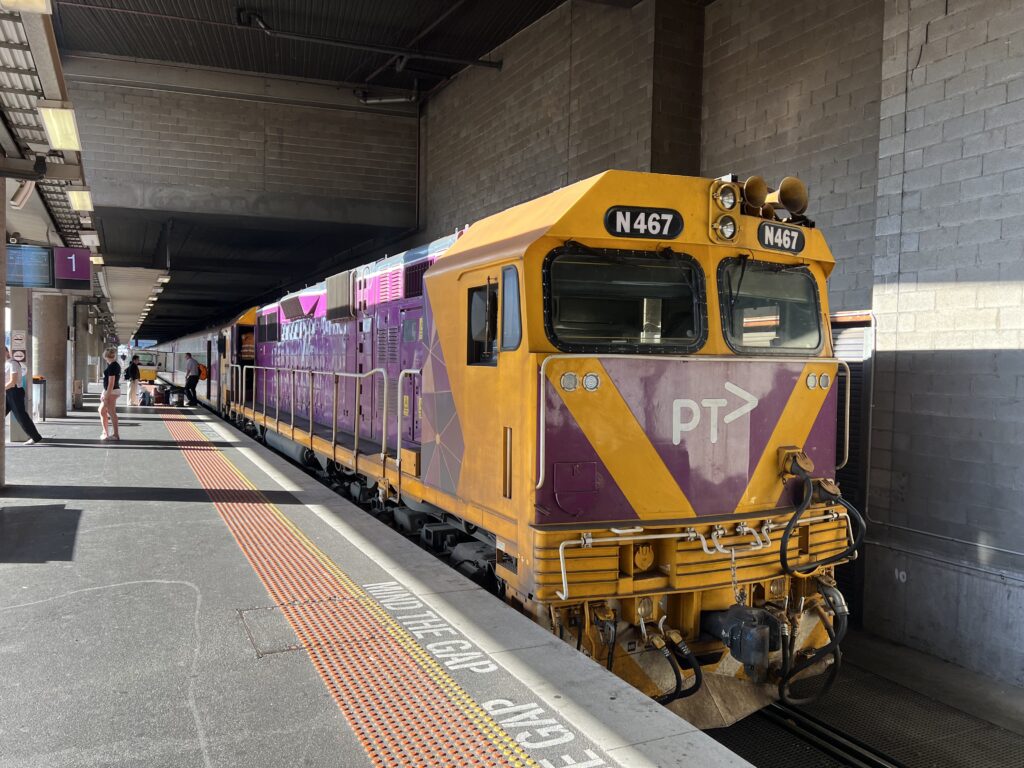





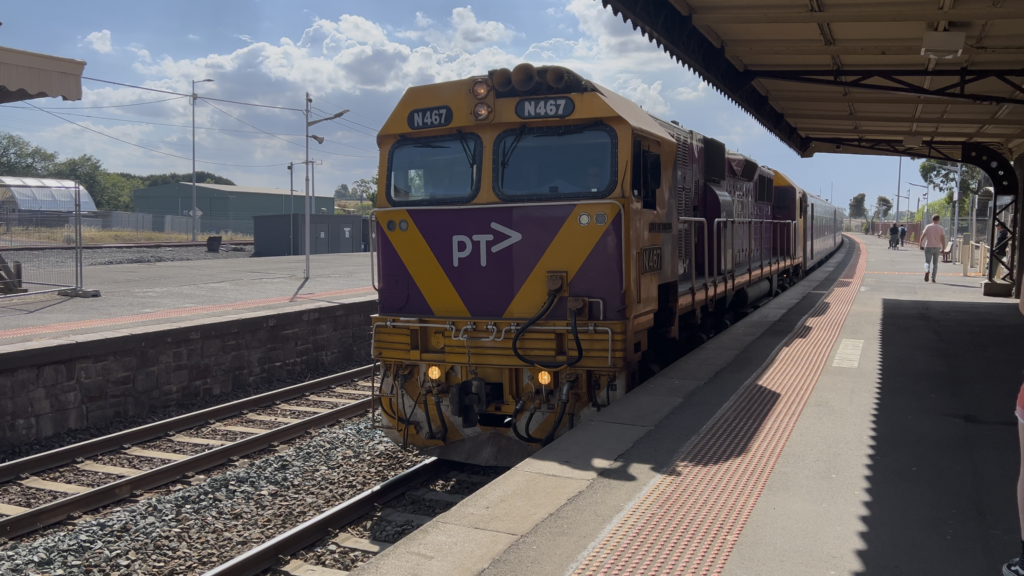
There is something uniquely satisfying about stepping aboard a locomotive-hauled passenger train in 2026. In an age dominated by streamlined multiple units, touchscreens, and increasingly homogenised rail experiences, classic diesel-hauled services feel increasingly rare—not just in Australia, but across the world. That rarity is exactly what made this particular journey aboard a V/Line N-class service from Kyneton to Melbourne feel special long before the train even arrived at the platform.
The journey began in the historic Macedon Ranges town of Kyneton, approximately 86 kilometres northwest of Melbourne. While many travellers simply pass through on the Bendigo corridor, Kyneton rewards anyone willing to spend a few hours exploring its beautifully preserved streetscapes, heritage buildings, gardens, and cafés. Yet for railway enthusiasts and transport lovers alike, the town offers another attraction entirely: one of the increasingly limited opportunities to ride a classic V/Line N-set locomotive-hauled train.
This review takes a comprehensive look at the entire experience—from station facilities and ticketing through to onboard comfort, ambience, value for money, ride quality, and the intangible nostalgia that makes these trains such an enduring part of Victorian railway culture.
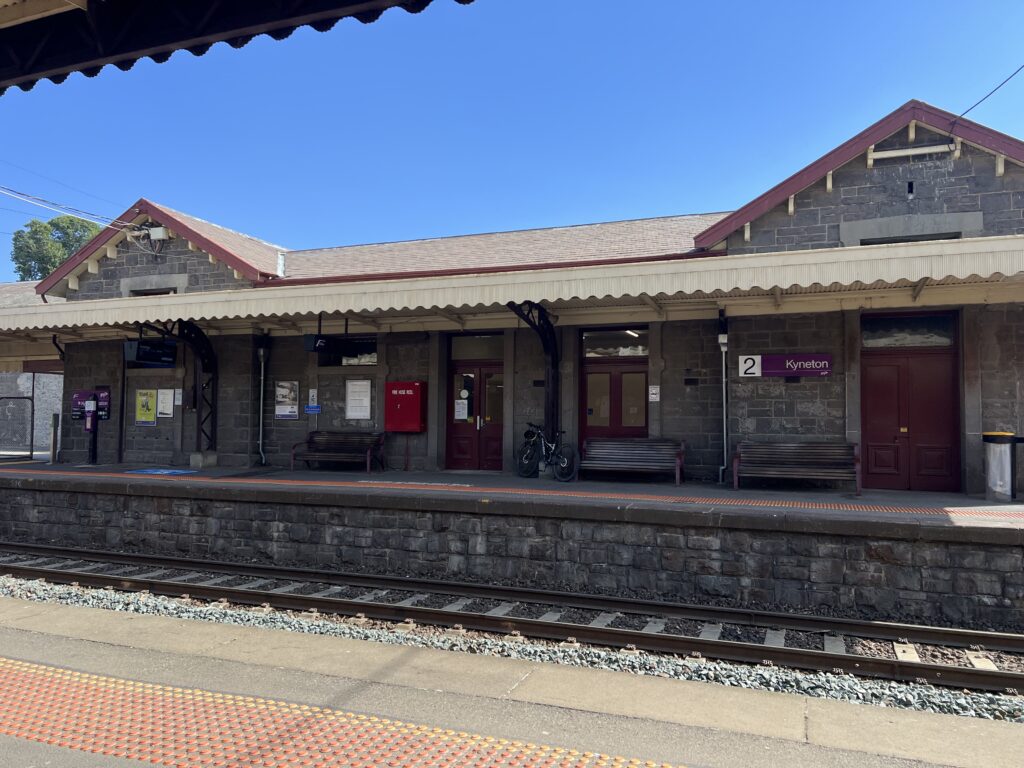
A Historic Setting: Kyneton Railway Station
A significant part of any rail journey is the environment in which it begins, and Kyneton Railway Station immediately sets the tone.
Dating back to 1862, the station remains one of regional Victoria’s most charming railway stops. Located roughly a 15-minute walk from the centre of town, the station reflects the golden era of Victorian railway expansion, when grand station buildings and substantial infrastructure were considered symbols of civic pride and economic ambition.
The architecture is distinctly nineteenth century, with heritage station buildings, broad platforms, and a sense of permanence that modern suburban stations often lack. While not lavish, the station feels authentic and lived-in. Unlike heavily redeveloped transport hubs, Kyneton retains much of its original railway atmosphere.
The Bendigo line itself remains one of Victoria’s most important regional corridors, connecting Melbourne with towns across central and northwestern Victoria. Today, the line primarily hosts modern VLocity diesel multiple units, which have become the backbone of the V/Line network. However, hidden among those contemporary services are a handful of locomotive-hauled operations worked by the venerable N-class locomotives and N-set carriages.
For enthusiasts, these trains have become increasingly elusive.
Historically, N sets operated across numerous regional corridors throughout Victoria. In recent years, however, their use has contracted significantly. Most remaining services now appear on the Swan Hill line, with occasional deployments elsewhere depending on operational requirements. As newer rolling stock continues to enter service, opportunities to experience these trains become rarer every year.
That growing scarcity adds genuine excitement to the experience.
Ticketing and Reservations: Exceptional Simplicity
One of the standout aspects of regional rail travel in Victoria remains its remarkable affordability and simplicity.
Using Victoria’s Myki ticketing system, passengers can travel enormous distances across the state for a capped daily fare. At the time of travel, the maximum statewide fare sat at an astonishingly low $11.40 AUD per day, representing arguably one of the best-value regional public transport systems anywhere in the developed world.
For context, this means travellers can journey from Melbourne to regional centres hundreds of kilometres away for less than the cost of many urban airport transfers worldwide.
That value proposition alone deserves enormous praise.
Boarding at Kyneton was refreshingly straightforward. There were no airport-style security checks, no mandatory advance reservations for Myki-zone travel, and no complicated fare structures. Passengers simply tapped on using their Myki cards and boarded.
That said, one major recommendation should absolutely be made for anyone travelling on an N-set service: reserve a seat if possible.
Unlike the largely open-seating arrangement found on VLocity services, locomotive-hauled trains benefit significantly from reserved seating, particularly if travellers want a guaranteed window seat or a quieter section of the train. Fortunately, obtaining a reservation was easy through the station ticket office, where staff proved exceptionally friendly and helpful.
The staff interaction deserves mention because good customer service increasingly feels uncommon in modern transport systems. The ticket office employee not only efficiently processed the reservation but also ensured placement in the first-class carriage—a welcome upgrade that elevated the experience considerably.
First Impressions: The Arrival of the N-Class
When the train finally rolled into Kyneton station, the contrast with modern VLocity units was immediate and unmistakable.
The V/Line N-class locomotive possesses genuine presence.
Built between 1985 and 1987, the N-class locomotives represent a fascinating transitional era in Australian railroading: modern enough to remain operational today, yet unmistakably rooted in traditional locomotive-hauled passenger rail philosophy. Their angular bodywork, bold V/Line livery, and distinctive diesel soundtrack create an atmosphere entirely different from contemporary multiple units.
There is theatre to a locomotive arrival.
The deep rumble of the diesel engine, the subtle vibrations through the platform, and the sight of stainless-steel carriages trailing behind the locomotive all combine to produce a far more dramatic experience than simply watching a self-propelled railcar glide into a station.
For rail enthusiasts, that sensory element matters enormously.
The train on this journey consisted of classic N-set rolling stock, including both economy and first-class accommodation, as well as the increasingly rare buffet car—a feature now almost extinct on Australian regional rail services.
Even before boarding, the train already felt like a throwback to another era of rail travel.
First-Class: Surprisingly Comfortable
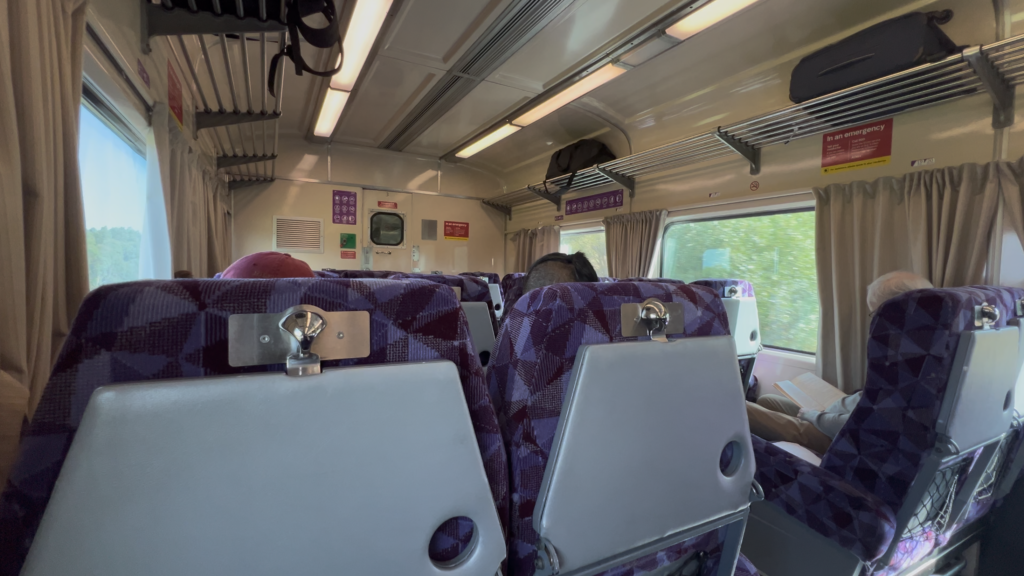
Stepping into the first-class carriage revealed an interior that was undeniably dated, yet also unexpectedly inviting.
This is not luxury rail travel in the modern premium sense. Passengers expecting sleek Scandinavian interiors, LED mood lighting, or airline-style entertainment systems will not find them here. Instead, the N-set offers something increasingly rare: traditional railway comfort.
The first-class seating configuration is arranged in a spacious 2+2 layout, immediately feeling more generous than the denser 2+3 arrangement found in economy class and on many VLocity services.
Legroom was excellent.
Even taller passengers should have little difficulty stretching out comfortably for journeys of several hours. The seats themselves were wide, well-padded, and supportive without being excessively firm. While the upholstery and fittings clearly reveal the train’s age, they also demonstrate the durability of older railway design philosophies.
One particularly pleasing feature was the tray table arrangement. Unlike many modern trains where tray tables feel flimsy and undersized, these fold-out tables were sturdy, practical, and genuinely useful for working, eating, or simply placing personal items.
Additional storage features included literature pockets and overhead luggage racks in classic open-rack style. Again, the atmosphere felt distinctly old-school in the best possible way.
Importantly, the cabin environment remained pleasantly quiet throughout the journey.
Despite the locomotive-haulage setup, noise levels inside the carriage were entirely acceptable. In fact, many passengers may actually prefer the subtle background hum and rail sounds compared with the harsher mechanical drone often associated with diesel multiple units.
The reviewer noted that the seating felt more comfortable overall than VLocity services—a sentiment likely to resonate with many regular Victorian rail passengers.
The Ambience: Why Old Trains Still Matter
One aspect impossible to fully quantify in any transport review is ambience.
Modern trains are often objectively superior in measurable categories such as acceleration, fuel efficiency, accessibility integration, and maintenance economics. Yet many fail to evoke any emotional connection whatsoever.
The N-set does the opposite.
From the moment the locomotive pulls away from the platform, passengers become aware they are travelling on a “real train” in the traditional sense. There is movement, sway, mechanical sound, and rhythm. Rail joints and track transitions produce audible feedback. Curves are negotiated with gentle body roll. Acceleration feels deliberate rather than instantaneous.
Some may see these as flaws.
Rail enthusiasts and traditionalists, however, recognise them as part of the romance of railway travel.
The train possesses character.
That character extends beyond mechanical operation and into the broader onboard atmosphere. The older interiors, buffet car, manually operated vestibule areas, and visible carriage transitions all create an experience that feels fundamentally different from contemporary commuter-oriented rolling stock.
It is difficult to imagine anyone passionately reminiscing about a standard diesel multiple unit thirty years from now. The N-set, by contrast, already inspires nostalgia while still operational.
The Buffet Car: A Vanishing Railway Tradition
Perhaps the single most charming feature aboard the train was the buffet car.
Once commonplace across long-distance rail services worldwide, buffet and dining facilities have largely disappeared due to cost-cutting measures and changing passenger expectations. Their continued presence aboard V/Line N-set services therefore feels wonderfully anachronistic.
The buffet offered a modest selection of snacks, drinks, and light refreshments rather than full dining service. Nevertheless, simply having the ability to walk through the train and purchase food from an onboard counter dramatically improves the overall travel experience.
It transforms the train from mere transportation into a journey.
Even passengers not intending to buy anything benefit psychologically from the existence of communal onboard spaces. The buffet car creates movement, social interaction, and a sense of railway culture absent from sealed commuter-style environments.
For regional journeys of several hours, this feature remains genuinely valuable.
One hopes V/Line recognises how beloved this aspect of the N-set experience remains among passengers.
Economy Class: Dense but Functional
A brief walk through economy class revealed a more utilitarian environment compared with first class.
The seating layout shifts to a denser 2+3 configuration, maximising passenger capacity while inevitably sacrificing some personal space. Nevertheless, the seats themselves still appeared reasonably comfortable by regional rail standards.
Interestingly, the train was much quieter than expected.
Given the popularity of regional Victorian services and the limited frequency of N-set operations, a heavier passenger load might have been anticipated. Instead, the relatively calm atmosphere enhanced the overall experience significantly.
Lower occupancy contributed to quieter cabins, easier movement through the train, and a generally more relaxed environment.
This highlighted another advantage locomotive-hauled regional services can still offer over crowded metropolitan-style operations: a sense of space and calm.
Ride Quality and Performance
In terms of ride quality, the N-set delivers a distinctly traditional railway experience.
Passengers accustomed exclusively to modern DMUs may initially notice more carriage sway and longitudinal movement. However, the suspension characteristics also provide a softer and more organic ride feel in many situations.
The train handled the Bendigo corridor competently throughout the journey.
Acceleration naturally lagged behind modern VLocity units, particularly departing stations, but this hardly mattered on a relaxed regional service. In fact, the slower, more measured pace arguably enhanced the journey’s atmosphere.
Window views across regional Victoria remained excellent throughout.
The route between Kyneton and Melbourne passes through attractive countryside, small regional settlements, and rolling landscapes characteristic of central Victoria. As daylight gradually softened into evening, the experience became increasingly scenic and reflective.
Importantly, punctuality remained respectable.
The train arrived slightly behind schedule but well within acceptable operational tolerances, especially considering the complexities of regional rail operations in Australia. Arrival into Melbourne’s Southern Cross Station similarly occurred only a few minutes late.
For a legacy locomotive-hauled service operating over a busy regional network, this represented a solid operational performance.
Onboard Facilities and Toilets
The onboard facilities reflected the broader theme of the train: functional, aging, but entirely adequate.
Both accessible and standard lavatories were inspected during the journey. Neither could be described as luxurious or especially modern, yet both remained serviceable and reasonably maintained.
The accessible toilet offered generous space and included all expected accessibility features. While signs of wear and occasional graffiti were visible, cleanliness standards remained acceptable for regional public transport.
The standard toilet similarly delivered a basic but functional experience.
These are not facilities likely to impress premium-travel enthusiasts, but they fulfilled their purpose competently enough.
Importantly, everything appeared operational—a detail that should never be underestimated on older rolling stock.
Southern Cross Arrival: Returning to Modernity
As the train approached Melbourne, onboard announcements prepared passengers for arrival at Southern Cross Station.
The contrast between the old-world regional train experience and Southern Cross itself felt striking. The station, with its sweeping modern roof structure, busy platforms, and urban energy, represents contemporary Australian transport infrastructure at full scale.
After roughly an hour onboard from Kyneton, the journey concluded smoothly at Platform 1.
Disembarking felt strangely bittersweet.
There is a growing awareness among rail enthusiasts that opportunities to experience locomotive-hauled passenger services in Australia are disappearing rapidly. Each journey aboard an N-set increasingly feels less like ordinary transportation and more like participation in living railway history.
Comparing the N-Set with VLocity Trains
No review of the N-class experience would be complete without comparing it to the VLocity fleet that now dominates V/Line operations.
Objectively, VLocity trains outperform N sets in several categories:
- Faster acceleration
- Improved accessibility integration
- More modern passenger information systems
- Greater operational efficiency
- Better compliance with contemporary standards
However, the N-set still holds meaningful advantages:
- Superior seat comfort
- More spacious first-class accommodation
- Buffet car availability
- Greater sense of railway atmosphere
- Smoother long-distance ambience
- Traditional locomotive-hauled character
The difference ultimately comes down to philosophy.
VLocity trains are highly effective transport tools. N sets feel like railway journeys.
That distinction matters enormously to many passengers.
Exceptional Value for Money
Perhaps the most remarkable aspect of the entire experience remains the value proposition.
For just $11.40 AUD, passengers could travel from Melbourne deep into regional Victoria and back again aboard a locomotive-hauled train with first-class seating and buffet facilities.
Globally, it is difficult to think of many comparable rail experiences offering such affordability.
In Europe, North America, or parts of Asia, equivalent heritage-adjacent regional rail experiences often command substantially higher fares. Victoria’s fare cap therefore creates extraordinary accessibility to regional travel.
This pricing structure encourages exploration, tourism, and public transport usage in ways many other jurisdictions struggle to achieve.
The reviewer’s spontaneous day trip to Kyneton perfectly demonstrated this advantage.
The Emotional Side of Railway Preservation
Although the N-set remains an operational part of the V/Line fleet rather than a preserved heritage train, journeys like this inevitably raise broader questions about railway preservation and transport identity.
Modernisation is necessary. Newer trains offer improved reliability, accessibility, efficiency, and compliance with contemporary expectations.
Yet something valuable is lost when classic rolling stock disappears entirely.
The N-class and N-set carriages represent a distinct chapter of Victorian railway history. They embody an era when regional rail travel balanced practicality with comfort and when long-distance journeys still retained traces of ceremony and occasion.
Preserving at least part of that experience matters culturally.
Not every train journey needs to feel identical.
Final Verdict
The V/Line N-class train from Kyneton to Melbourne delivered exactly what great regional rail journeys should provide: comfort, atmosphere, reliability, character, and exceptional value.
Was it perfect? No.
The interiors are visibly aging. Toilets are basic. Accessibility integration cannot match modern standards. Performance lags behind contemporary rolling stock.
Yet none of those factors diminish the train’s essential charm.
In fact, many of the qualities that make the N-set special stem directly from its age and traditional design philosophy. The locomotive ambience, buffet car, spacious seating, and old-school railway atmosphere combine to create something increasingly uncommon in modern public transport: personality.
For railway enthusiasts, the service is absolutely worth seeking out before eventual retirement arrives.
For casual travellers, it offers a fascinating and comfortable alternative to standard regional rail experiences.
And for Victorians, it serves as a reminder that some older transport traditions still possess enduring value even in an increasingly modernised network.
The reviewer’s conclusion ultimately feels entirely justified: if you have even the slightest interest in rail travel, classic trains, or regional Victoria, you should absolutely experience a V/Line N-class service while you still can.
Because one day soon, these trains will be gone—and with them, a small but meaningful piece of Australian railway history.