





Flying across Australia is always a big journey — but when you’re doing it on a low-cost carrier’s oldest aircraft type, the Jetstar Airbus A321CEO, it’s a true test of endurance. In this detailed review, we’ll take a deep dive into the full experience onboard Jetstar’s early-morning service from Melbourne to Perth, on what many consider to be the airline’s most notorious aircraft. With cramped seating, minimal onboard features, and a mixed reputation, can the A321CEO still hold up in 2025?
Surprisingly, this trip across the continent on flight JQ972 had more than a few pleasant twists. From Melbourne’s cold winter morning to a stunning sunrise departure, and from Jetstar’s surprisingly smooth check-in to an unexpectedly tasty onboard meal, this was a flight that might just challenge Jetstar’s reputation for discomfort.
A Cold Melbourne Morning and the Cheapest Way Home
It all began in the heart of Melbourne, the capital of Victoria — Australia’s bustling southern metropolis and now, by some measures, the nation’s most populated city. With more than five million residents, Melbourne rivals Sydney in both size and energy. I’d been in town for a quick winter weekend getaway to see a couple of AFL games, including my beloved Fremantle Dockers taking on Collingwood at the MCG.
As every Perth local knows, getting home from Melbourne on a Monday morning isn’t cheap — especially during the footy season or school holidays. Full-service airlines like Qantas and Virgin Australia were quoting over $1,000 one-way. So when Jetstar offered a fare for around $340 with the Flex Plus bundle, it was an easy decision. The early 6:20 a.m. departure wasn’t ideal, but the price was right.
Originally, this flight was supposed to be operated by Jetstar’s newer and more comfortable Airbus A321neo, but checking the seat map the night before revealed a surprise — the aircraft had been swapped for the older A321-200CEO variant. The CEO (short for “Current Engine Option”) is a high-density, 230-seat workhorse with a reputation for tight legroom and no-frills interiors.
That last-minute equipment change also affected my seat. The Flex Plus bundle had included an exit-row seat on the Neo with a window — a perfect combo of legroom and views. But on the A321CEO, my assigned exit row seat suddenly became a regular one with no window. By the time I noticed, all the good seats were gone. I managed to reselect 26A, one of Jetstar’s extra-legroom rows, but again, no real window — just a partial one a few inches ahead.
It wasn’t ideal, but it would do. And besides, it gave me a perfect reason to finally review Jetstar’s classic A321 — an aircraft I’d somehow never featured before on Aussie JetSetter.

Pre-Dawn Departure from Melbourne Airport
At 3 a.m., the alarm clock jolted me awake. Outside, the Docklands were freezing, and the streets were empty. I made my way to Southern Cross Station to catch the first SkyBus to Melbourne Airport, officially known as Tullamarine (MEL).
Even at that hour, Tullamarine was buzzing. Handling more than 35 million passengers annually, it’s Australia’s second-busiest airport. Jetstar operates out of Terminal 4 (T4), the home of low-cost and regional carriers like Rex, Link Airways, and the now-defunct Tigerair and Bonza.
To my surprise, check-in was fast and efficient — not something you often hear in the same sentence as “Jetstar.” Melbourne’s T4 has fully automated self-service kiosks and bag drops. You simply enter your booking reference, print your boarding pass and bag tag, and drop your luggage onto the belt. Everything worked seamlessly.
Security, on the other hand, was typically busy. But with efficient CT scanners, there was no need to remove laptops or liquids, and I was through in under 10 minutes.

Gate 45 and the Aging A321CEO
With boarding time approaching, I found my gate — Gate 45, deep inside T4’s long concourse. The crowd was mostly leisure travelers and families, many of them, like me, returning home after a weekend of footy.
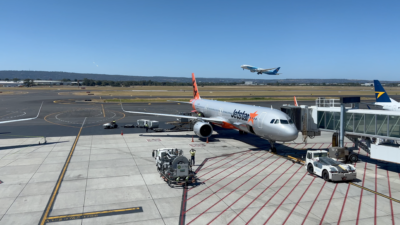
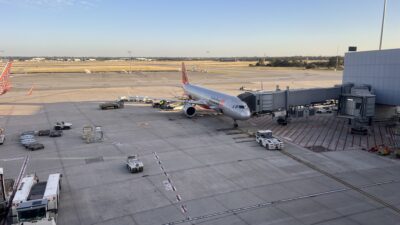
Out the window, I caught my first glimpse of the aircraft: VH-VWW, a 16-year-old Airbus A321-231CEO delivered new to Jetstar in May 2009. It looked clean and well maintained for its age — but still unmistakably part of Jetstar’s older generation of planes.
At 6 a.m., boarding began by airstairs, with no photos allowed on the tarmac. The queue was long but moved quickly, and the mood was upbeat. Many passengers were still wearing Dockers scarves from the night before — a sea of purple in the early morning light.
Onboard Jetstar’s Old Workhorse
The A321CEO cabin layout is simple: all economy class, with either 220 or 230 seats, depending on configuration. Mine was the denser version with 230 seats — and it felt every bit of it.
The seat pitch is just 28 inches, the tightest of any narrow-body flying regularly within Australia. Width is a standard 18 inches, and recline a minimal 3 inches. My 26A seat, while missing a proper window, offered nearly unlimited legroom thanks to its location by the emergency exit.
The seats themselves are firm but not unbearable. The upholstery is basic black leather with orange stitching — a familiar Jetstar look. Unlike the newer A321neo, there are no USB ports, power outlets, or device holders. It’s very much old-school low-cost flying.
As the cabin filled to capacity, the captain announced a short delay for weight and balance adjustments due to the full load. The crew handled it professionally, and soon enough we were taxiing toward Runway 27 for departure into a crisp Melbourne sunrise.

Takeoff from Melbourne and Climbing to 32,000 Feet
Without a proper window, I had to contort myself to film the takeoff through the pane behind me — not ideal, but good enough to catch glimpses of the city waking up below. As the engines roared, the A321CEO accelerated powerfully down the runway, lifting off gracefully into the golden morning light.
It was a classic Jetstar departure — quick, efficient, and with no frills. Moments later, we pierced through the clouds, leveling off at 32,000 feet. The seatbelt sign switched off, and the crew began preparing for service.
Inflight Service and the $15 Flex-Plus Voucher
The first announcement reminded passengers that those who had pre-purchased meals or vouchers would be served first. My Flex Plus bundle included a $15 food and beverage credit, so it was time to explore the Jetstar Café menu.
The options were fairly standard: soft drinks, coffee, beer and wine, light snacks, sandwiches, and a few hot items like toasties and pastries. On longer routes, Jetstar sometimes offers hot meals like lasagna or teriyaki noodles, but today’s flight featured only the lighter fare.
I redeemed my $15 voucher for a beef pie and sausage roll combo with a Pepsi, and to my surprise, it was delicious — hearty, hot, and far more filling than expected. For an airline often criticized for stingy portions, this was a genuine highlight.
The crew were friendly and efficient, even with a packed cabin. The buy-on-board service ran smoothly, and despite the lack of Wi-Fi or seatback entertainment, the experience felt pleasant enough for a low-cost flight.
Cabin and Lavatory Check
Mid-flight, I took a quick look around the cabin. Lighting was soft, the mood relaxed, and most passengers were either watching downloaded content or napping.
Jetstar’s A321CEO features three lavatories — one at the front and two at the rear. That’s actually more than Qantas’ brand-new A321XLR economy cabin, which only has two. For 230 passengers, it works out to roughly one lavatory per 76 people, perfectly reasonable for a narrow-body aircraft.
The lavatory was compact but functional — clean mirror, baby change table, coat hook, and a sink that worked properly. It may not sound like much, but it’s a small win for an aircraft type known for bare-bones amenities.
In-Flight Entertainment (or Lack Thereof)
Entertainment on the A321CEO is minimal to none. While newer A321neos and much of Jetstar’s A320 fleet now offer Jetstar Entertainment Plus, a paid streaming service that lets you watch movies and TV shows on your own device, this older jet doesn’t support it.
That means it’s entirely bring-your-own-device flying — download your own content, bring a good playlist, or just catch some sleep. Given the early departure, I did exactly that. With only a few hours’ rest from the night before, I spent much of the cruise dozing and watching the sunrise creep across the cabin.
Crossing the Continent
Three hours into the flight, the endless blue of the Great Australian Bight gave way to the rugged coastline of Western Australia. From 32,000 feet, you could just make out the rolling hills and dry landscape near Esperance and the Wheatbelt.
Soon, the captain came over the PA with arrival details: light winds, clear skies, and a crisp 5 °C in Perth. Despite leaving late, we’d made up most of the delay in the air.

Descent and Arrival into Perth
As we began descending, the sun finally filled the cabin, casting a warm glow over the orange Jetstar logo. The approach offered fleeting views of the Perth Hills though my seat made photography difficult. Still, it was a beautiful landing into the western capital.
The cabin crew made their final announcements, thanking passengers for choosing Jetstar and reminding everyone to watch their step on the airstairs.
Touchdown was smooth, and after a short taxi, we parked at Perth Airport’s Terminal 2 — Jetstar’s new home since late 2024.
Perth Arrival and Terminal Change Notes
Arriving into Terminal 2 is a relatively new experience for Jetstar passengers. Previously, Jetstar operated from the Qantas domestic terminal, but since 2024 the airline has moved to T2 — traditionally known as Perth’s FIFO (fly-in fly-out) and regional terminal.
This change makes connections to Jetstar International flights easier, as the International Terminal 1 is just a short walk away. However, it also means that connections to Qantas domestic services now require a 10-minute road transfer, and there’s no access to the Qantas Club lounge before departure.
Still, Perth’s Airport Central Train Station is conveniently located nearby, offering a quick and affordable connection into the city. I took the train home, tired but satisfied with how surprisingly smooth the entire flight had been.
Final Thoughts: Jetstar at Its Best
After catching up on some sleep back home, it was time to reflect on the experience. For my first coast-to-coast Jetstar flight in years, it had gone far better than expected.
For $342 AUD with the Flex Plus bundle, the flight offered exceptional value — especially compared to the $800-$1,000 fares on Qantas and Virgin. The bundle includes checked luggage, seat selection, Qantas Points earning, a $15 voucher, and most importantly, full fare flexibility. You can make unlimited changes (paying only fare differences) or even cancel for a flight credit.
It’s the most affordable flexible fare product in Australia, and for anyone booking months ahead or during uncertain times, it’s a smart choice.
The flight itself was perfectly acceptable. The cabin crew were professional, the food surprisingly good, and the aircraft — though aging — performed flawlessly. Even with the limited comfort and lack of amenities, the journey didn’t feel like a chore.
If I had to nitpick, two points stand out:
- The aircraft swap wasn’t communicated properly, which caused issues with my seat selection.
- Baggage delivery at Perth took far too long, likely due to the full load.
But overall, Jetstar did everything right where it mattered. The experience was exactly what you’d expect for the price, and in many ways, better than the airline’s reputation suggests.
Verdict: Jetstar’s Oldest A321 Still Has Life Left
So, is Jetstar’s A321CEO really as bad as its reputation? In 2025, not necessarily. While it’s far from luxurious, the experience was more comfortable and reliable than expected.
With a good seat, the Flex Plus bundle, and realistic expectations, the A321CEO remains a perfectly viable way to cross Australia on a budget.
You don’t fly Jetstar for frills — you fly it for function, price, and punctuality. On this Melbourne to Perth run, it delivered on all three.

Disclaimer: This article has been repurposed from the original transcript of my own flight review with the assistance of AI technologies. Please be advised whilst I have taken the utmost care to review and revise this article where necessary to reflect the upmost of accuracy at time of publication please be advised my reviews whether written or in video form are for entertainment and general information purposes only. They reflect the objective views in good faith of the person only whom is presenting them unless otherwise noted. Any decisions you make resulting from consuming my content must take into consideration your own circumstances, research and responsibility as I can not be hold responsible for any inaccuracies or future changes effecting the relativity of such reviews. All Rights Reserved by Aussie JetSetter from 2022 >