




Virgin Australia has spent the past few years modernising its domestic fleet with the arrival of the Boeing 737 MAX 8, introducing quieter cabins, updated seating, USB charging, improved passenger comfort and greater fuel efficiency. With many of the airline’s newest aircraft now operating major transcontinental routes, the five-hour journey between Sydney and Perth provides an excellent opportunity to see how the MAX 8 performs on one of Australia’s longest domestic flights.
For this review, I travelled on Virgin Australia flight VA551 from Sydney to Perth aboard one of the airline’s newest Boeing 737 MAX 8 aircraft, delivered only two months before my flight. Covering more than 3,280 kilometres across the Australian continent, this service is one of Virgin Australia’s flagship domestic routes and represents a true test of both passenger comfort and onboard service.
Would the new aircraft justify the growing reputation surrounding Virgin Australia’s latest fleet investment, or would it simply feel like another Boeing 737 with a fresh interior?
Here’s my complete review.
Flight Details
Airline: Virgin Australia
Flight: VA51
Route: Sydney (SYD) – Perth (PER)
Aircraft: Boeing 737 MAX 8
Registration: VH-VAG
Seat Class: Economy
Flight Time: 4 hours 29 minutes
Scheduled Flight Time: 5 hours 15 minutes
Distance: 3,284 km
Aircraft Age: Approximately 2 months
Getting to Sydney Airport
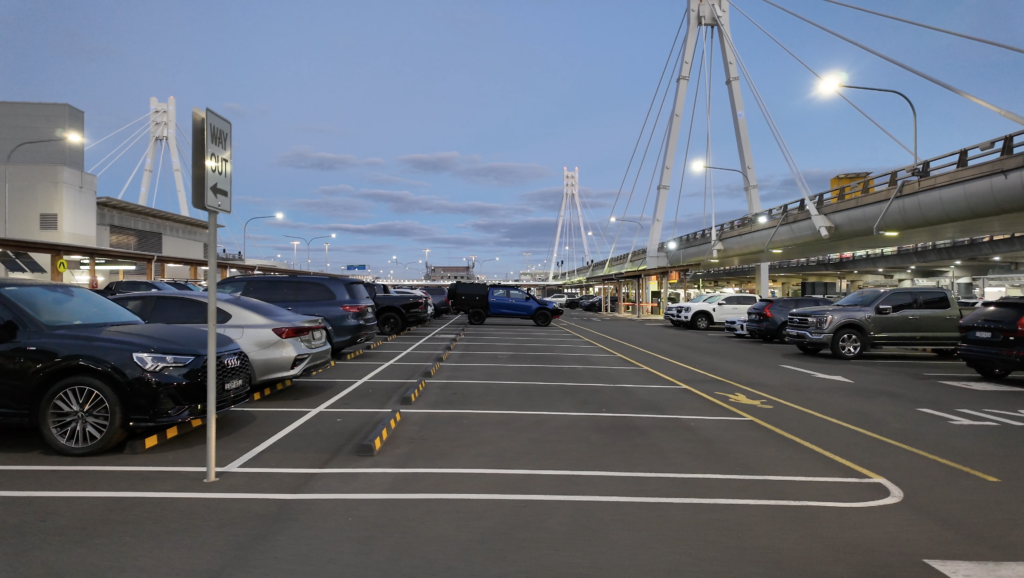
Rather than taking Sydney’s Airport Link train directly to the domestic terminal, I decided to avoid the station access surcharge by getting off one stop earlier at Mascot Station before walking the remaining 20 to 25 minutes to Terminal 2.
For travellers carrying only hand luggage, this proved to be an easy and surprisingly pleasant walk during the early morning, saving almost $20 in airport station access fees. While there is normally a public bus connecting Mascot Station with the airport terminals, it wasn’t operating at around 5:00 am on the morning of my flight, making walking the simplest option.
It is a useful travel tip for anyone looking to reduce transport costs when flying domestically from Sydney Airport.
Sydney Airport
Sydney Kingsford Smith Airport remains Australia’s busiest airport and serves as the country’s primary international gateway.
Handling well over forty million passengers annually, the airport can become extremely busy during weekday morning peaks, particularly in Terminal 2 where Virgin Australia operates the majority of its domestic services. The airport’s proximity to Sydney’s CBD makes it exceptionally convenient, although it also means future expansion opportunities remain limited compared with Melbourne Airport or the soon-to-open Western Sydney International Airport.
As expected for a Monday morning, the terminal was already bustling well before sunrise.
Check-in Experience
One of the more unusual aspects of this journey was Virgin Australia’s temporary check-in arrangement.
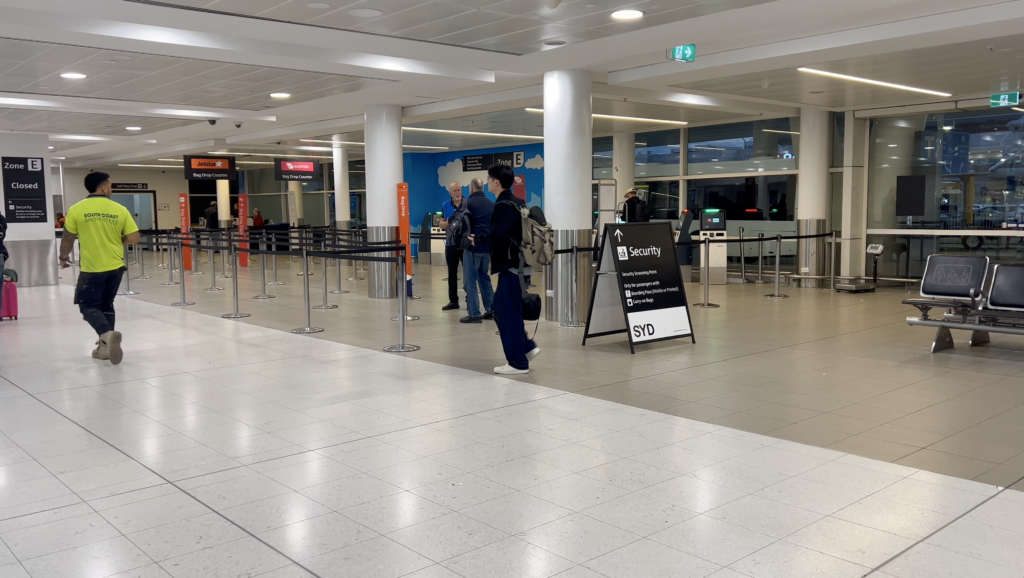
After entering Terminal 2 via the arrivals level, I unexpectedly encountered a temporary self-service check-in area downstairs rather than the airline’s normal check-in facilities upstairs.
Following self-service bag tagging, baggage was manually accepted by staff before being transferred onto a conveyor system, suggesting renovation works or capacity improvements were taking place elsewhere within the terminal.
Despite the unconventional setup, the process proved remarkably efficient.
There were virtually no queues, staff were friendly, and I was through check-in within minutes before using an alternative security screening point that was equally quiet and well organised.
Sometimes temporary arrangements can actually improve the passenger experience, and that was certainly the case here.
Virgin Australia Lounge Sydney Review
Access to the Virgin Australia Lounge was provided through my American Express Velocity Platinum Card, allowing entry before boarding.
Sydney’s Virgin Australia Lounge is the airline’s flagship domestic lounge and one of the largest within its network.
Unfortunately, timing proved to be everything.
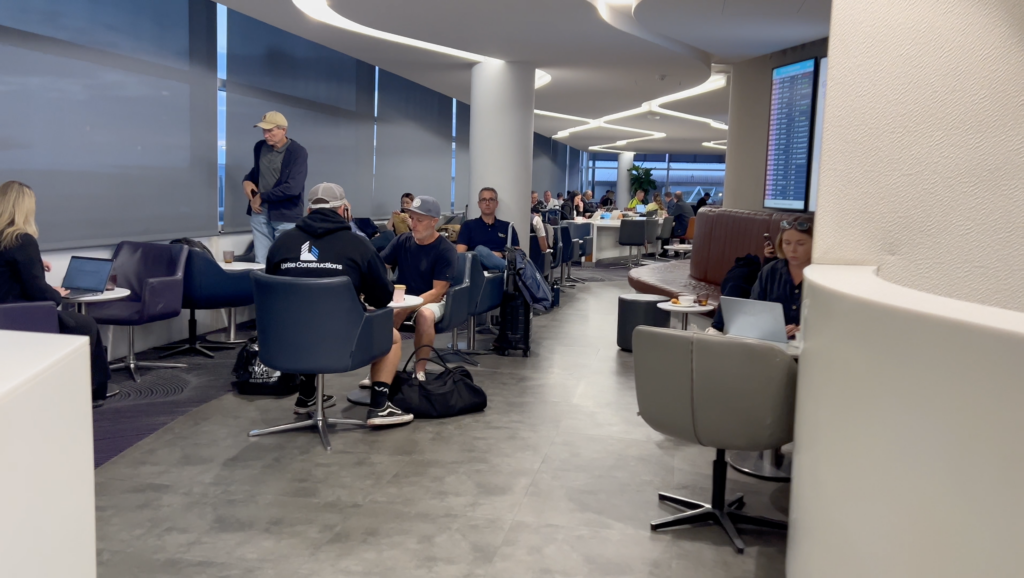
Arriving around 6:30 am on a Monday morning meant entering one of the busiest periods of the week, and the lounge was absolutely packed.
Finding an available seat required some patience, with many passengers clearly travelling for business. Compared with Perth, where FIFO workers often dominate weekday departures, Sydney’s clientele had a noticeably corporate atmosphere, with business travellers filling almost every available workspace.
The lounge itself maintains Virgin Australia’s familiar contemporary styling, offering a wide variety of seating options, power outlets and a self-service buffet.
Breakfast consisted of chicken sausages, baked beans and orange juice.
While perfectly adequate for a complimentary lounge meal, the food offering wasn’t especially memorable and the lengthy queues for both coffee and breakfast significantly detracted from the overall experience.
The overcrowding wasn’t really the lounge’s fault.
Instead, it reflected Sydney’s heavy weekday morning departure schedule.
If you’re hoping to enjoy a quieter visit, choosing flights outside the weekday commuter rush would likely provide a far more relaxing experience.
Boarding
Boarding commenced exactly on schedule, with passengers split between the aerobridge at the front of the aircraft and rear stairs for those seated towards the back of the cabin.
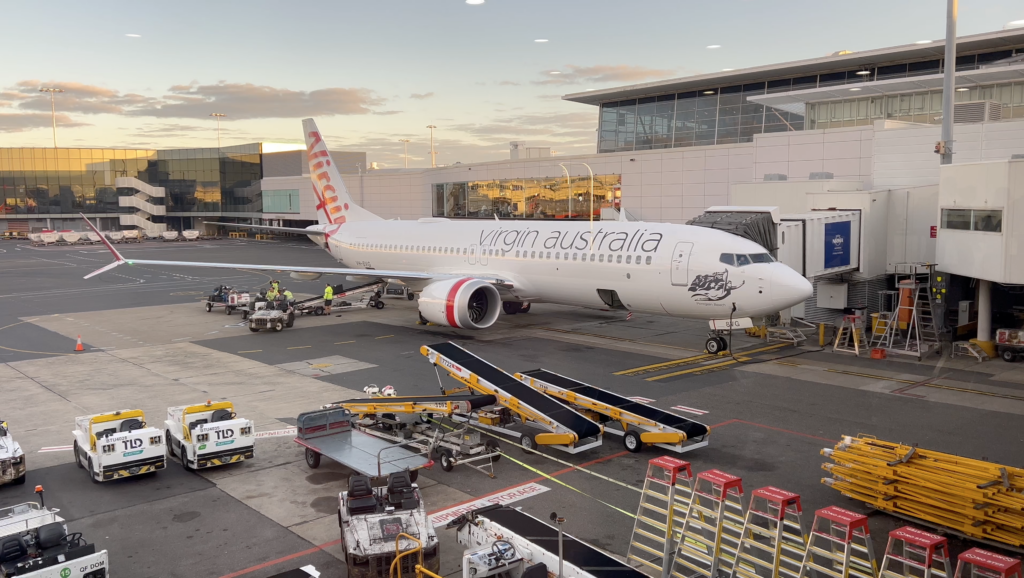
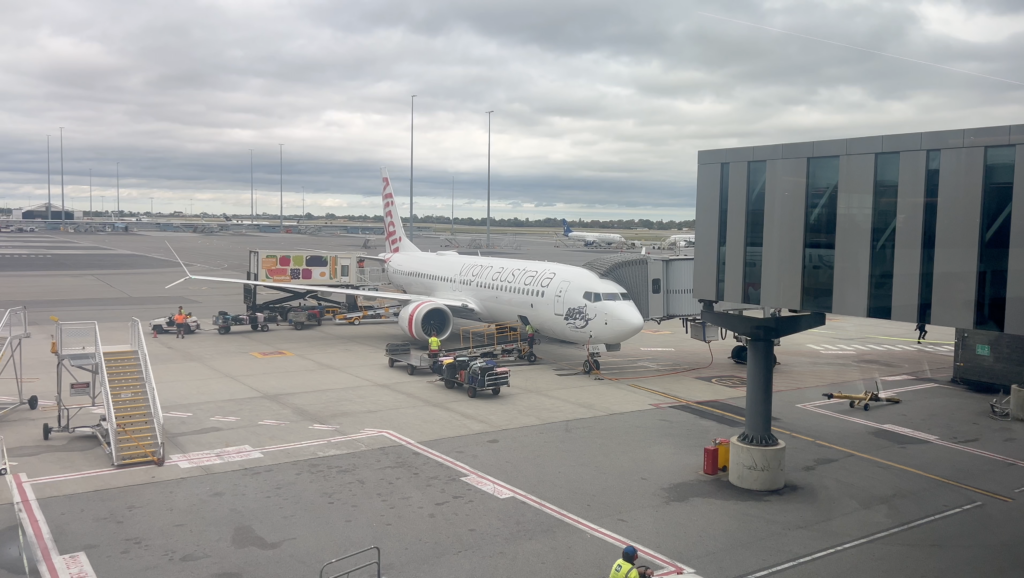
Waiting on the stand was an almost brand-new Boeing 737 MAX 8 registered VH-VAG, nicknamed Peregian Beach.
Delivered only two months before my flight, the aircraft represented one of Virgin Australia’s newest additions and formed part of the airline’s steadily growing MAX fleet.
Walking across the apron towards such a new aircraft immediately created a positive first impression.
Everything from the pristine exterior to the spotless cabin reflected an aircraft that had barely entered commercial service, setting high expectations for the five-hour journey across Australia.
Cabin and Seat Review
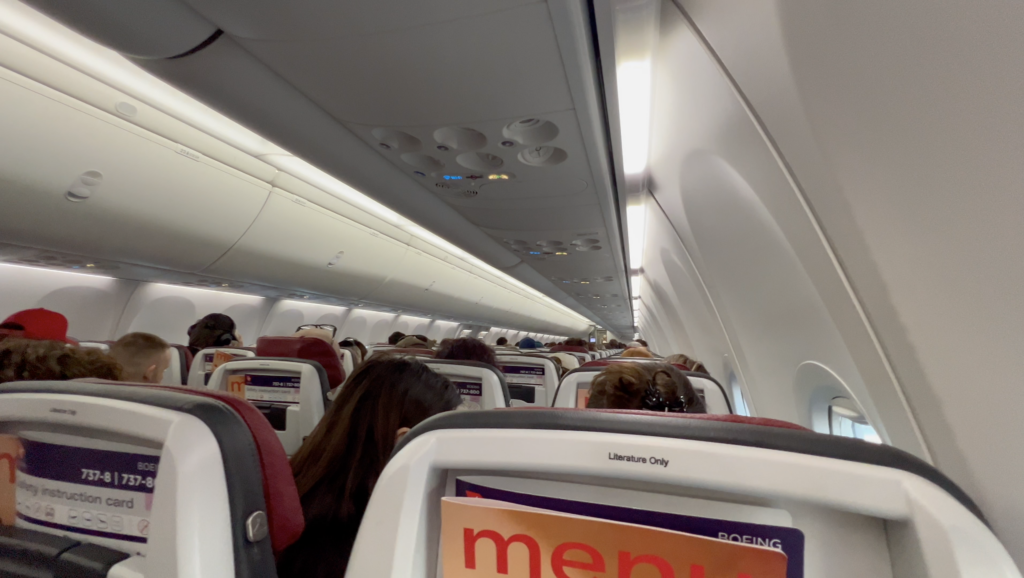
Stepping onboard, it quickly became apparent that Virgin Australia’s Boeing 737 MAX 8 represents a noticeable step forward from the airline’s older Boeing 737-800 fleet. Although the cabin layout remains familiar, the newer aircraft feels brighter, more modern and considerably more refined thanks to Boeing’s latest Sky Interior, updated lighting and redesigned passenger seating.
Virgin Australia’s MAX 8 fleet accommodates between 176 and 182 passengers depending on configuration, including a small eight-seat Business Class cabin at the front and the remainder dedicated to Economy. Economy X, the airline’s extra-legroom product, occupies the forward rows of the main cabin and offers approximately 34 inches of seat pitch compared with around 30 to 31 inches in standard Economy.
Although my flight departed completely full, boarding was well organised and passengers settled into their seats quickly without unnecessary delays.
Economy Seat Comfort
One of the biggest improvements aboard Virgin Australia’s Boeing 737 MAX 8 is undoubtedly the new generation Economy seating.
After spending more than four hours onboard, I found these to be among the most comfortable narrow-body Economy seats currently operating within Australia.
The seats feature supportive ergonomic cushioning, high-quality black leather upholstery and an adjustable headrest that proved particularly valuable on a long transcontinental sector. While seat pitch remains broadly similar to the airline’s older aircraft, improved seat design creates a more spacious and comfortable feeling throughout the flight.
Another welcome addition is the inclusion of USB charging at every seat, allowing passengers to keep phones and tablets powered throughout the journey without requiring a power bank.
Virgin Australia has also incorporated an integrated device holder positioned conveniently for tablets or smartphones, making it considerably easier to watch entertainment without needing to balance a device on the tray table.
These small enhancements significantly improve the overall passenger experience, particularly on flights exceeding four hours.
Even with every seat occupied, I remained comfortable throughout the journey and never felt particularly fatigued, something that cannot always be said of older Boeing 737 cabins.

Taxi and Take-off
Pushback occurred on schedule before we joined the steady stream of Monday morning departures at Sydney Airport.
After a relatively short taxi, the aircraft accelerated smoothly down the runway before climbing out over Sydney under slightly hazy autumn conditions.
Passengers seated on the left-hand side were rewarded with spectacular aerial views across Sydney Harbour, the city skyline and surrounding suburbs, providing one of Australia’s most scenic domestic departures.
The quieter LEAP-1B engines fitted to the Boeing 737 MAX 8 also became immediately noticeable during climb.
Compared with previous generations of the Boeing 737, cabin noise levels felt noticeably reduced, contributing to a far more relaxed atmosphere during the early stages of the flight.
Inflight Entertainment
Virgin Australia continues to utilise its wireless “Stream” entertainment platform rather than installing traditional seatback screens.
Passengers simply connect their personal device to the aircraft’s onboard Wi-Fi network before accessing the entertainment portal through a web browser.
The content library proved impressive.
There was an excellent selection of recently released films alongside evergreen favourites, complete television series, children’s programming and podcasts, providing enough variety to comfortably occupy passengers on Australia’s longest domestic routes.
The system was responsive, easy to navigate and streamed reliably throughout the flight.
My only real criticism concerns the absence of a moving flight map.
For aviation enthusiasts and frequent travellers alike, following the aircraft’s progress across Australia is often one of the most enjoyable parts of flying, making its omission slightly disappointing on such a long journey.
Despite this, Virgin Australia’s entertainment platform remains one of the stronger wireless systems offered by Australian domestic airlines.
Wi-Fi
Wi-Fi is available throughout the Boeing 737 MAX 8 fleet.
Business Class passengers receive complimentary access, while Economy passengers can purchase either a short-duration pass or full-flight access.
At the time of my flight, pricing was approximately $9.75 for a 30-minute session or $19.95 for unlimited access during the entire flight.
Although I personally chose not to purchase Wi-Fi on this occasion, the full-flight option appears reasonably priced considering the journey lasts more than five hours.
For business travellers needing to remain connected or passengers wanting to browse the internet throughout the crossing, it represents fair value when compared with many international carriers.
Food and Beverage
Virgin Australia’s domestic Economy product continues to operate under a buy-on-board model, with complimentary tea, coffee and water remaining available to all passengers.
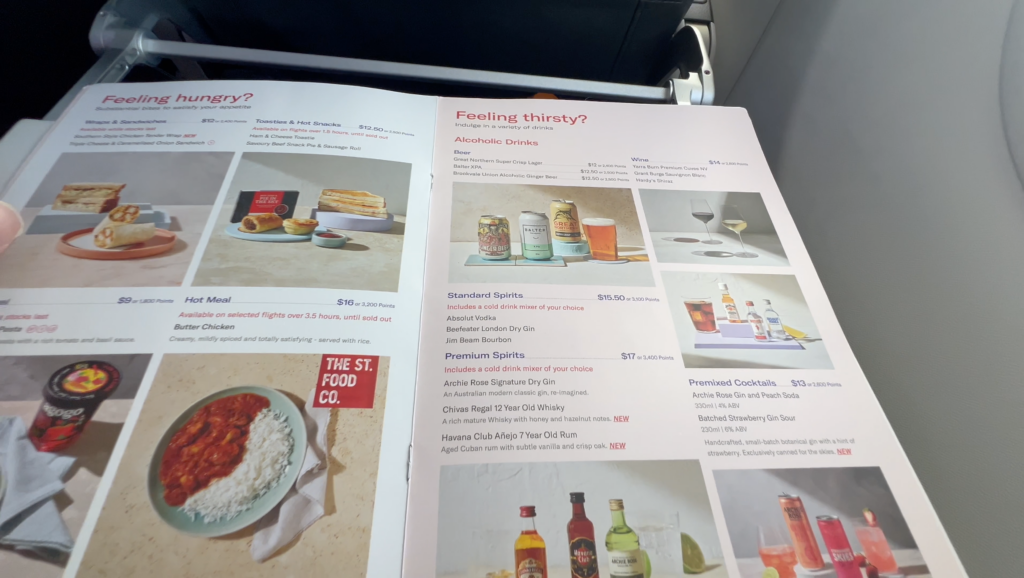
The menu itself is comprehensive and caters well to a variety of travellers.
Passengers can choose from snacks, pastries, toasties, sandwiches, more substantial meals on selected routes, alcoholic beverages, soft drinks and even travel essentials should they need them during the flight.
Pricing is certainly towards the premium end of the market.
However, meal combinations provide slightly better value than purchasing individual items separately.
Virgin Australia also allows purchases using Velocity Frequent Flyer points, although I would strongly recommend paying with cash or card instead.
Redeeming Velocity Points for onboard food generally represents poor value compared with using those points towards flights or upgrades.
Given my early morning departure and a busy day ahead after arriving in Perth, I opted to keep things simple by enjoying one of the complimentary coffees before settling in for the remainder of the flight.
The coffee was perfectly acceptable, and while the complimentary offering remains fairly modest, it is always appreciated on a long domestic journey.
Cabin Facilities
During the flight I also took the opportunity to inspect one of the rear Economy lavatories.
Given the aircraft was only a few months old, the facilities were in excellent condition and presented exactly as you would expect from a modern narrow-body aircraft. Although compact, the lavatory felt clean, bright and well maintained, with practical features including a baby change table, coat hook and touch-free waste disposal. There was nothing particularly revolutionary about the design, but everything functioned well and cleanliness remained excellent throughout the flight.
On a flight exceeding four hours, maintaining clean cabin facilities can make a significant difference to the overall passenger experience, and Virgin Australia’s cabin crew clearly kept on top of this throughout the journey.
Cabin Atmosphere
With the service complete, the remainder of the flight settled into a relaxed and comfortable cruise across the Australian continent.
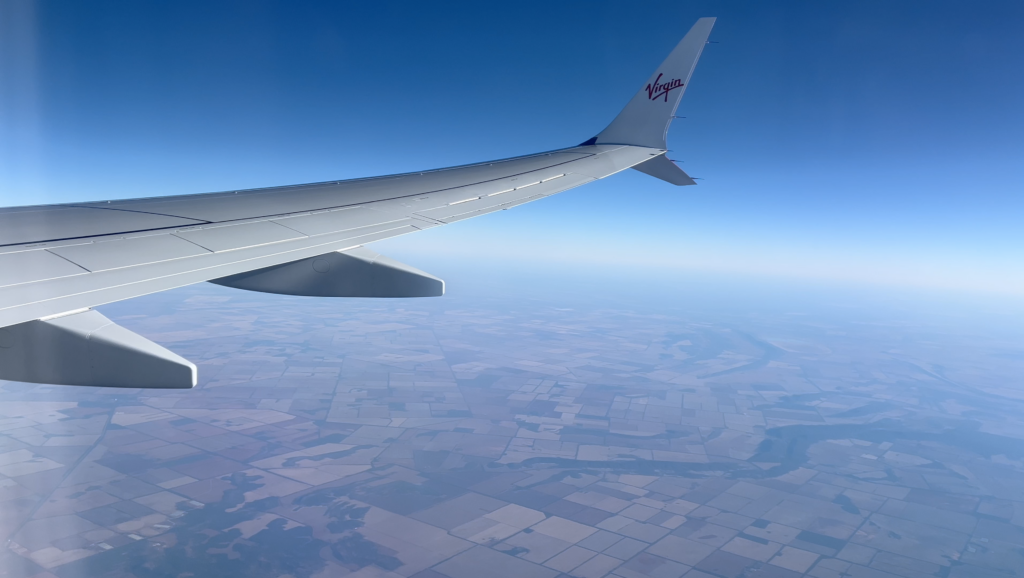
Unfortunately, weather conditions meant there was little to see for much of the journey, with extensive cloud cover stretching across large sections of South Australia and Western Australia. Nevertheless, the aircraft provided a noticeably quieter cabin environment than earlier Boeing 737 variants, making it easy to relax, work or simply enjoy the inflight entertainment.
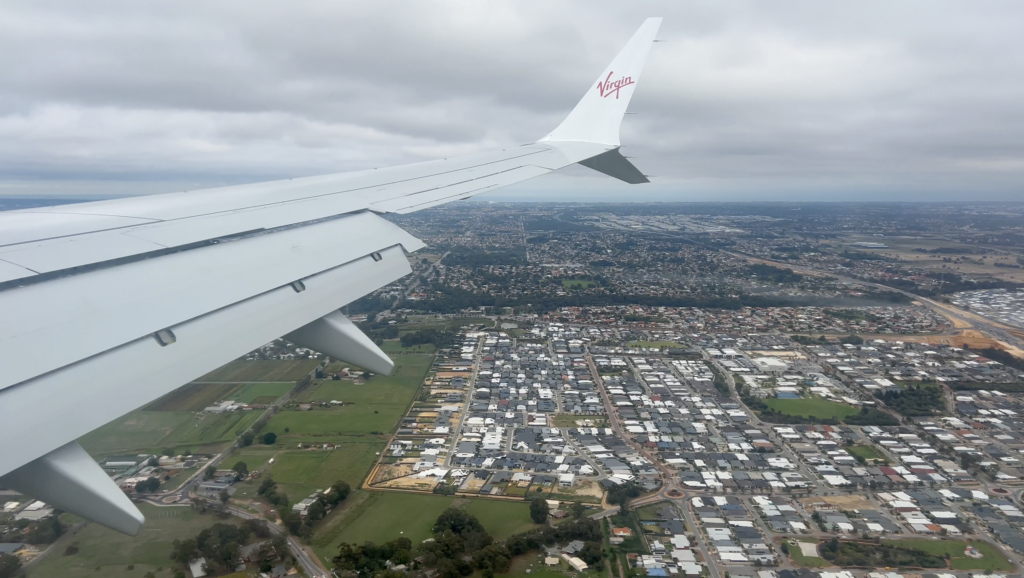
As we crossed into Western Australia, the clouds gradually cleared, revealing the rugged coastline east of Esperance before beginning our descent towards Perth. The approach into Western Australia’s capital is always an enjoyable one, particularly when arriving from the east, as the landscape slowly transforms from vast open countryside into Perth’s expanding suburban skyline.
Cabin Crew and Service
Virgin Australia’s cabin crew once again delivered one of the airline’s strongest assets.
From boarding through to arrival, every interaction was friendly, genuine and professional.
Announcements were clear without feeling overly scripted, requests from passengers were handled efficiently, and the crew maintained a warm and approachable attitude throughout the five-hour journey. Even during a completely full flight, service remained calm and well organised, reflecting the consistency for which Virgin Australia has become known within the Australian domestic market.
While Virgin Australia’s Economy service is intentionally simple, the professionalism of the cabin crew continues to elevate the overall experience beyond what the buy-on-board model alone might suggest.
Arrival into Perth
One of the biggest surprises of the journey came towards the end of the flight.
Favourable winds allowed us to make excellent progress across the continent, with the flight deck announcing that we were expected to arrive around 25 minutes ahead of schedule. After a smooth descent into Perth, we touched down shortly before 10:00 am local time, significantly earlier than originally planned.
Early arrivals are always appreciated, particularly on long domestic sectors where passengers often have onward meetings, connecting flights or family commitments.
Taxi to the gate was quick, and within minutes passengers were disembarking into Perth’s domestic terminal, bringing an enjoyable transcontinental journey to a close.
Value for Money
Assessing value for money on this particular flight requires some context.
In my case, the flight itself was effectively complimentary, having been redeemed through the annual Virgin Australia domestic flight benefit included with my American Express Velocity Platinum Card. Considering the return Perth–Sydney itinerary would ordinarily have cost well in excess of $1,000, the annual card fee represented excellent value based on my own travel patterns.
Of course, that calculation won’t apply to every traveller.
For passengers purchasing tickets outright, Virgin Australia generally occupies the middle ground between Jetstar’s low-cost model and Qantas’ more traditional full-service offering.
The airline’s pricing often reflects this positioning, delivering a noticeably more refined onboard experience than a typical low-cost carrier without reaching the premium pricing that Qantas can command during peak periods.
When competitive fares are available, particularly on long domestic routes such as Sydney to Perth, Virgin Australia represents excellent value.
The newer Boeing 737 MAX 8 only strengthens that proposition.
Virgin Australia 737 MAX 8 vs Older 737-800
Although both aircraft share the same basic design philosophy, Virgin Australia’s newest Boeing 737 MAX 8 offers several meaningful improvements over the older Boeing 737-800 fleet.
The most obvious differences include a noticeably quieter cabin, modern Boeing Sky Interior lighting, improved seating ergonomics, USB charging ports and integrated device holders at every seat.
Individually these may appear to be relatively minor upgrades, but together they create a significantly more comfortable passenger experience on flights lasting four to five hours.
Perhaps most importantly, the seats themselves are genuinely comfortable.
After spending almost four and a half hours onboard, I stepped off the aircraft feeling considerably less fatigued than I typically do after similar flights on older narrow-body aircraft.
That alone speaks volumes about the improvements Virgin Australia has made with its latest fleet investment.
How Does Virgin Australia Compare?
For travellers choosing between Australia’s three largest domestic airlines, each offers a distinctly different experience.
Jetstar remains the clear choice for travellers whose primary concern is obtaining the lowest possible fare, although passengers should expect to pay extra for baggage, meals and seat selection.
Qantas continues to provide complimentary meals and beverages in Economy, alongside seatback entertainment on selected aircraft, but fares can often be significantly higher than Virgin Australia’s equivalent services.
Virgin Australia arguably strikes the most balanced position in today’s domestic market.
While complimentary catering is limited to tea, coffee and water, passengers receive a modern aircraft, comfortable seating, excellent cabin crew, reliable onboard entertainment and a polished overall experience without paying full-service airline prices.
For many travellers, particularly those flying longer domestic routes, that combination is likely to represent the sweet spot between affordability and comfort.
Final Verdict
Virgin Australia’s Boeing 737 MAX 8 has quickly become one of the best narrow-body aircraft currently flying within Australia.
The aircraft feels modern, quiet and thoughtfully designed, with comfortable seating, practical in-seat technology and a noticeably more refined cabin environment than previous generations of the Boeing 737.
Although the Sydney Virgin Australia Lounge struggled to cope with the Monday morning rush, that was by far the weakest aspect of the overall experience and reflected timing rather than any shortcomings in the lounge itself.
Once onboard, the experience improved considerably.
Friendly cabin crew, punctual operations, reliable entertainment, comfortable seating and an early arrival all combined to deliver an excellent transcontinental flight across Australia.
If you’re specifically booking a Virgin Australia flight, I’d strongly recommend choosing a Boeing 737 MAX 8 service whenever possible.
It offers a genuine improvement over the airline’s older aircraft and comfortably ranks among the best Economy Class experiences currently available on Australian domestic routes.
Frequently Asked Questions (FAQ)
Is the Virgin Australia Boeing 737 MAX 8 comfortable?
Yes. The Boeing 737 MAX 8 is one of the most comfortable narrow-body aircraft currently flying in Australia. Virgin Australia’s ergonomic leather seats, adjustable headrests, USB charging ports and quieter cabin make a noticeable improvement over the airline’s older Boeing 737-800 fleet, particularly on long domestic routes such as Sydney to Perth.
Does Virgin Australia have seatback entertainment on the Boeing 737 MAX 8?
No. Instead of seatback screens, Virgin Australia offers a wireless entertainment platform that streams movies, television shows, podcasts and children’s content directly to your smartphone, tablet or laptop using the aircraft’s onboard Wi-Fi network.
Is Wi-Fi available on Virgin Australia’s Boeing 737 MAX 8?
Yes. Wi-Fi is available throughout the Boeing 737 MAX 8 fleet. Business Class passengers receive complimentary access, while Economy passengers can purchase either a 30-minute pass or unlimited access for the duration of the flight.
Does Virgin Australia provide free meals on Sydney to Perth flights?
Economy passengers receive complimentary tea, coffee and water. Food and alcoholic beverages are available to purchase through Virgin Australia’s buy-on-board menu. Business Class passengers receive complimentary meals and beverages.
Is Virgin Australia better than Jetstar?
For most travellers, yes. Virgin Australia offers a noticeably more premium experience with superior seating, friendlier service, complimentary beverages and a more refined onboard product. Jetstar generally wins on price but offers fewer inclusions.
Is Virgin Australia better than Qantas?
Both airlines offer excellent domestic products, but they appeal to different travellers. Qantas provides complimentary meals in Economy and retains a more traditional full-service model. Virgin Australia often offers lower fares while still delivering excellent customer service and one of Australia’s most comfortable narrow-body cabins.
How long is the flight from Sydney to Perth?
Most direct flights take between 4 hours 30 minutes and 5 hours 15 minutes depending on weather conditions and prevailing winds.
Pros
- Modern Boeing 737 MAX 8 aircraft
- Excellent seat comfort
- Quiet cabin
- USB charging at every seat
- Integrated device holder
- Friendly and professional cabin crew
- Reliable wireless entertainment
- Good punctuality
- Comfortable for long domestic flights
- Excellent overall value
Cons
- No moving flight map
- Buy-on-board catering in Economy
- Sydney Lounge can become extremely crowded during weekday mornings
- Wi-Fi is an additional cost in Economy
Who Should Fly Virgin Australia?
Virgin Australia’s Boeing 737 MAX 8 is an excellent choice for:
- Business travellers flying between Australia’s major cities.
- Leisure travellers wanting more comfort than a low-cost carrier.
- Frequent flyers looking to maximise Velocity benefits.
- Travellers flying long domestic sectors such as Perth, Darwin or Cairns.
- Aviation enthusiasts wanting to experience Virgin Australia’s newest aircraft.
Disclaimer: This article has been repurposed from the original transcript of my own flight review on the Aussie JetSetter Youtube channel with the assistance of AI technologies. Please be advised whilst I have taken the utmost care to review and revise this article where necessary to reflect the upmost of accuracy at time of publication please be advised my reviews whether written or in video form are for entertainment and general information purposes only. They reflect the objective views in good faith of the person only whom is presenting them unless otherwise noted. Any decisions you make resulting from consuming my content must take into consideration your own circumstances, research and responsibility as I can not be hold responsible for any inaccuracies or future changes effecting the relativity of such reviews. All Rights Reserved by Aussie JetSetter from 2022 >


