




Few domestic flights in Australia showcase the sheer scale of the country quite like the journey between Darwin and Perth. Stretching more than 2,600 kilometres across the remote Kimberley, Pilbara and vast interior of Western Australia, the route links Australia’s tropical Top End with its largest western city in just under four hours. While the scenery is spectacular by day, this particular flight would be operated entirely after sunset, making the onboard experience the true focus of the journey.
Having spent several fantastic days exploring Darwin and Litchfield National Park over the Western Australia Day long weekend, it was unfortunately time to return home to Perth. Originally, this flight was scheduled to operate on one of QantasLink’s Airbus A319s, the same aircraft type I had flown north only a few days earlier. However, just hours before departure, Qantas made a last-minute aircraft substitution, replacing the A319 with one of Network Aviation’s Airbus A320s—an aircraft that many aviation enthusiasts will immediately recognise as a former Jetstar jet.
That change immediately made the journey more interesting.
These Airbus A320s only recently joined the QantasLink fleet after spending around two decades flying in Jetstar colours. Although the aircraft now proudly wear the Flying Kangaroo, relatively little has changed inside the cabin, meaning passengers are effectively travelling on what is still very much a low-cost carrier interior despite purchasing a full-service Qantas ticket.
Would the familiar Qantas service compensate for the ageing Jetstar cabin? After almost four hours in Economy Class, I was about to find out.
Flight Overview
This evening’s service was Qantas flight QF1743 from Darwin to Perth, scheduled to take just under four hours. On today’s flight, the expected flying time had actually been reduced to only three hours and thirty-nine minutes thanks to favourable winds, with the aircraft cruising at 36,000 feet for most of the journey.
After departing Darwin, our route would initially track southwest over the Timor Sea before crossing the rugged Kimberley region. From there we’d continue across the vast Pilbara and Western Australia’s sparsely populated interior before descending into Perth late in the evening.
It is a route that perfectly demonstrates Australia’s incredible size. Even after nearly four hours in the air, passengers remain entirely within one country.
Darwin Airport
Darwin International Airport has always been one of Australia’s more interesting airports.
Located approximately eight kilometres north of the city centre in the suburb of Eaton, the airport performs a dual role, sharing its primary runway with RAAF Base Darwin, one of the Royal Australian Air Force’s most important northern bases.
Although Darwin is Australia’s smallest mainland capital city by population, the airport punches well above its weight, handling around 1.8 million passengers annually. It offers connections to nearly every Australian capital city while also serving as the primary gateway for many remote communities throughout the Northern Territory.
Its geographical location also makes Darwin Australia’s closest capital city to much of Southeast Asia. Destinations including Singapore, Bali, Guangzhou and Dili are all within relatively short flying times, giving the airport an international role that is unique among Australia’s smaller capitals.
Check-in Experience
One aspect that immediately impressed me was just how effortless the departure process proved to be.
Darwin Airport has embraced self-service technology, with communal check-in kiosks serving multiple airlines including Qantas, Virgin Australia, Jetstar, Airnorth and Singapore Airlines.
Unlike many airports where airlines have largely abandoned printed boarding passes, Qantas still provides a traditional paper boarding pass at Darwin, something I personally appreciate. While mobile boarding passes are undeniably convenient, there is still something reassuring about having a physical boarding pass in hand.
After checking in, baggage drop was equally straightforward. Simply scanning the boarding pass, confirming the usual security declarations and placing the suitcase onto the conveyor belt took no more than a couple of minutes.
Everything worked exactly as intended.
Efficiency continued through security screening, where there was virtually no queue whatsoever. Darwin Airport’s modern CT scanners meant electronic devices and liquids could remain inside hand luggage, making the entire process remarkably quick compared with many larger Australian airports.
From entering the terminal to clearing security took only a matter of minutes—a refreshing start to the evening.

A Quick Visit to One of Qantas’ Best Lounges
One unexpected bonus for this journey was the opportunity to visit the Darwin Qantas Club using a complimentary lounge invitation.
Unfortunately, after maximising every available minute exploring Darwin during the day, there wasn’t much time remaining before boarding commenced. My lounge visit would ultimately last little more than twenty minutes.
Even so, it was enough to remind me why I consider Darwin one of the finest Qantas Clubs anywhere in Australia.
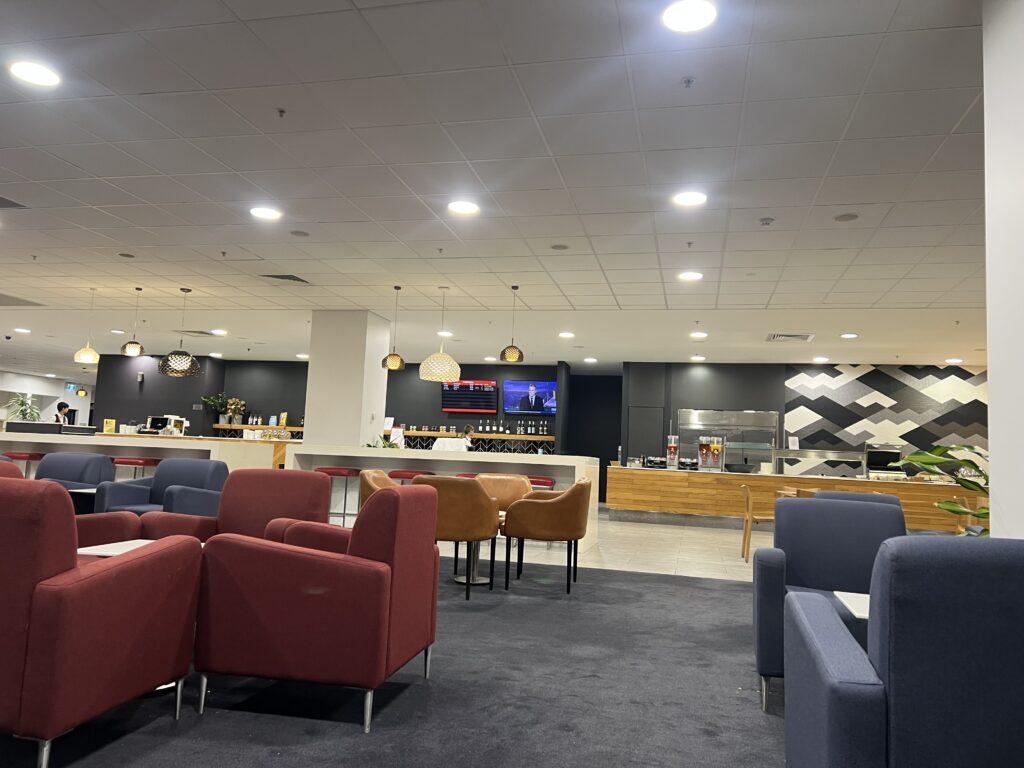
Unlike some of the airline’s busier lounges in Sydney or Melbourne, Darwin offers an atmosphere that is calm, spacious and genuinely relaxing. The lounge occupies one large rectangular room with an impressive variety of seating options catering for solo travellers, couples and business passengers alike.
The self-service buffet provides a respectable selection of hot and cold food, while a fully attended bar operates from midday onwards. Fresh barista-made coffee, business facilities and reliable high-speed Wi-Fi complete what is a very well-rounded lounge experience.
Although my visit was brief, there was still enough time to enjoy a cold beer after a long day exploring Darwin’s tropical heat before making my way towards the departure gate.
It was an excellent start to the journey and reinforced my opinion that Darwin remains one of the standout Qantas Club lounges across the airline’s domestic network.
Boarding a 20-Year-Old Former Jetstar Airbus A320
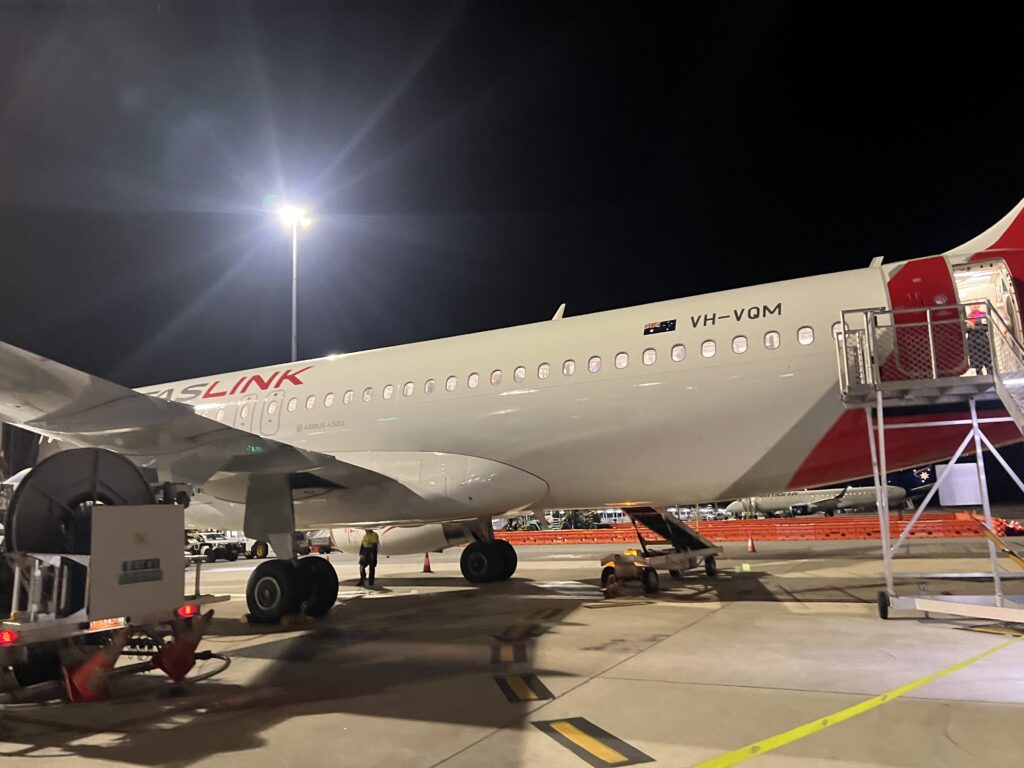
As boarding time approached, it quickly became apparent that tonight’s flight would be operating with a relatively light passenger load. Waiting at the gate was VH-VQM, a little over 20 years old and one of the Airbus A320s transferred from Jetstar to Network Aviation in late 2025. While the aircraft now wears the QantasLink livery, aviation enthusiasts will immediately recognise its history, as it spent almost two decades flying for Jetstar before beginning its second career in Western Australia.
For passengers, this aircraft swap represented an interesting contrast. The Airbus A319 originally scheduled for the service offers a cabin purpose-built for QantasLink’s regional operations, whereas these inherited A320s still retain much of their original low-cost configuration. The difference becomes obvious the moment you step onboard.
Boarding itself was handled efficiently. Passengers seated towards the front entered via the aerobridge, while those seated further aft boarded using the rear stairs. Splitting passengers between two entry points significantly sped up the process, and before long everyone was comfortably seated ahead of an on-time departure.
Punctuality is something Qantas generally performs well with, and this evening proved no exception. Boarding commenced on schedule, the doors were closed promptly and, after a short taxi, we were soon departing tropical Darwin for the long journey south-west to Perth.
First Impressions of the Cabin
Stepping inside, there was little doubt about the aircraft’s origins.
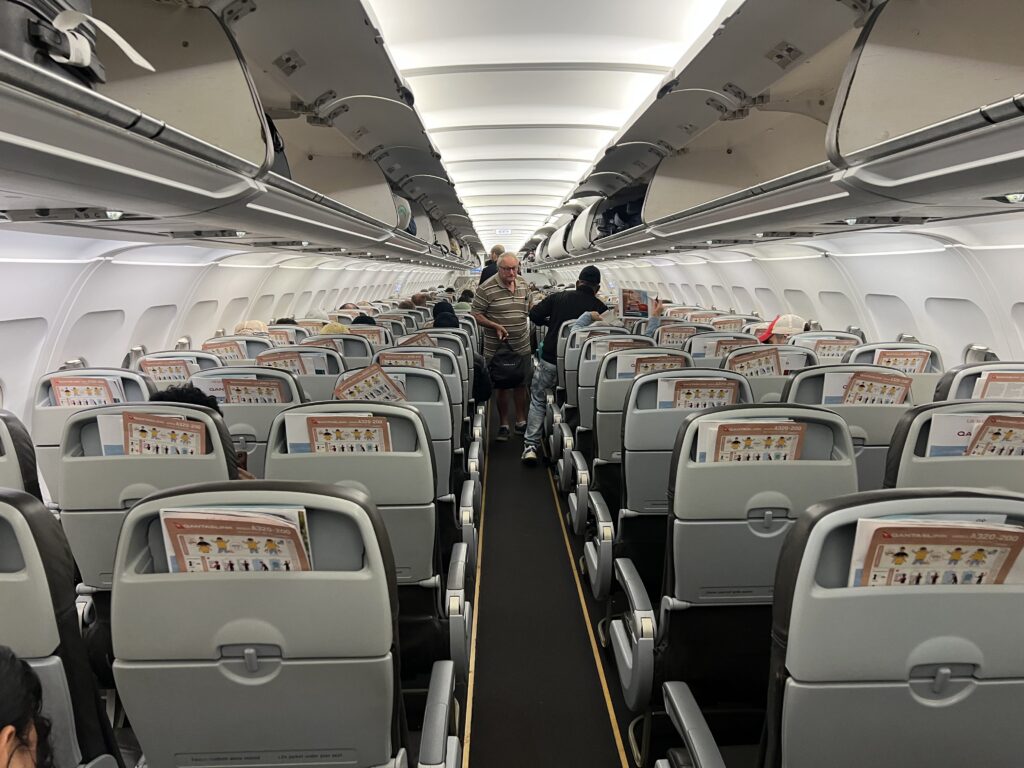
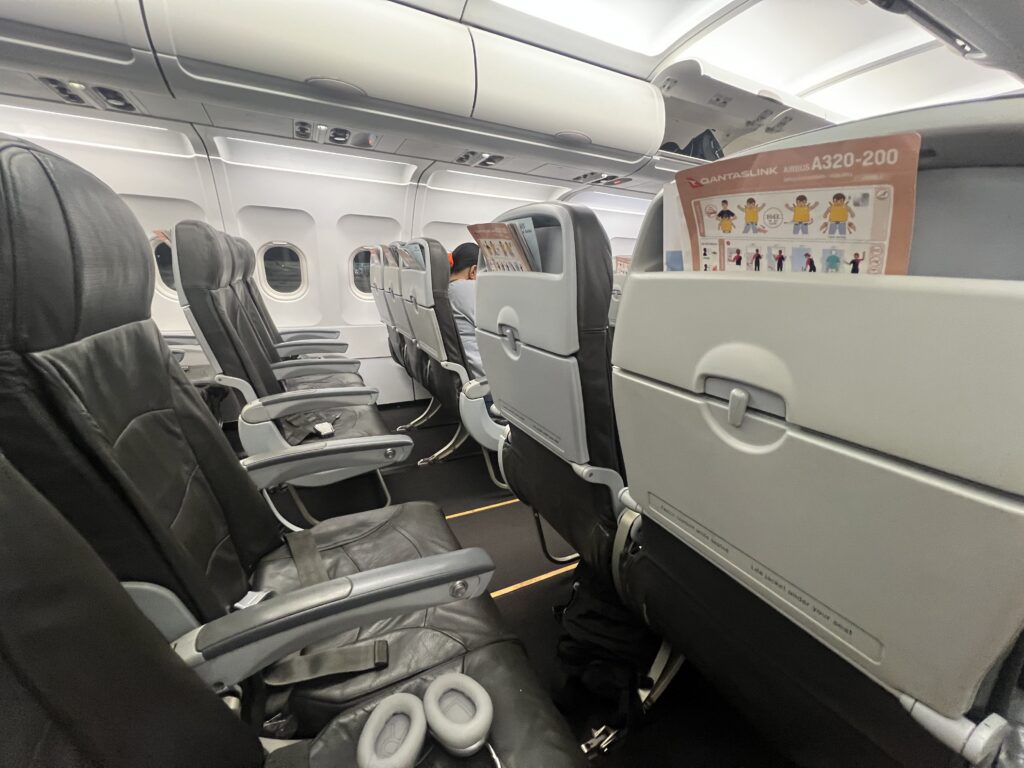
Although the aircraft now operates under the QantasLink brand, the cabin still feels unmistakably Jetstar. The familiar slimline leather seats remain largely untouched, with relatively basic tray tables and minimal seat-back features. Unlike newer aircraft entering airline fleets around the world, there are no seat-back entertainment screens, power outlets or premium design touches to elevate the experience.
Instead, passengers are presented with a very functional cabin that prioritises capacity over comfort.
Configured with 180 all-economy seats, the Airbus A320 forms the backbone of Network Aviation’s expanding operations throughout Western Australia. While perfectly adequate for shorter sectors, this layout begins to show its limitations on flights approaching four hours in duration.
The Biggest Weakness: Seating Comfort
Without question, the seating is the weakest aspect of the entire QantasLink A320 experience.
Seat pitch measures between approximately 28 and 30 inches, although it certainly feels closer to the lower end of that range once seated. Legroom is noticeably restricted, particularly for taller passengers, while the original Jetstar leather seats provide relatively little cushioning for longer flights.
Considering passengers are paying full-service Qantas fares, the cabin simply doesn’t match expectations.
It is somewhat surprising that so little has changed since these aircraft left Jetstar. While repainting the exterior into QantasLink colours undoubtedly provides a fresh appearance, passengers spend their entire journey inside the aircraft rather than admiring it from the terminal. The unchanged cabin serves as a constant reminder of the aircraft’s low-cost origins.
Fortunately, I enjoyed one significant advantage that dramatically improved the experience.
Tonight’s flight was far from full, allowing me to occupy an entire row to myself after take-off. Having three seats available instead of one transformed what could have been a rather uncomfortable four-hour journey into a much more relaxing experience. Being able to stretch out made a noticeable difference and certainly softened many of the shortcomings associated with the seating.
Climbing Out of Darwin
After departing Darwin, the aircraft climbed smoothly through the warm tropical evening before levelling off at our cruising altitude of 36,000 feet.
Flying at night naturally meant there was little to see outside the window once darkness settled across northern Australia. During daylight, this route offers spectacular aerial views of the rugged Kimberley coastline, vast deserts and isolated mining regions that define Australia’s north-west. However, with darkness enveloping the landscape below, attention quickly shifted towards evaluating the onboard product instead.
The flight itself proved remarkably smooth.
Weather conditions throughout the journey were excellent, and aside from occasional light cloud approaching Perth, there was very little turbulence encountered during the nearly four-hour sector. Combined with the relatively quiet cabin, it made for a peaceful and uneventful flight across the continent.
Cabin Facilities
Like most Airbus A320s, this aircraft features one lavatory at the front of the cabin and two at the rear.
Although basic in design, I found the facilities to be clean, tidy and well maintained. Essential amenities including a baby changing table, coat hook and standard toiletries were all present, and considering this was still relatively early in the flight, cleanliness was exactly what passengers would hope to find.
While there is nothing particularly remarkable about the lavatories, they reflected the overall professionalism of the cabin crew in maintaining a pleasant onboard environment throughout the evening.
Entertainment: Good Content, But Missing Features
Despite lacking traditional seat-back entertainment screens, Qantas continues to offer its Stream to Your Deviceentertainment platform aboard the Airbus A320 fleet.
Passengers simply connect their smartphone or tablet to the onboard wireless network to access a respectable library of movies, television series, children’s programming, audiobooks and music. The selection caters to a broad audience and compares favourably with many other Australian domestic airlines.
Personally, I rarely rely on airline entertainment systems, preferring to download documentaries and other content onto my own device before travelling. Nevertheless, for passengers who forget to prepare entertainment in advance, the available library should comfortably occupy much of the flight.
One disappointing issue during this journey was the inflight moving map.
Normally one of my favourite features on any flight, the map failed to display our aircraft’s position or flight information for the entire journey. While hardly a major inconvenience, it was unfortunate given the fascinating route across some of Australia’s most remote landscapes.
Another notable omission remains onboard Wi-Fi.
Unlike Qantas’ Boeing 737-800s and Airbus A330s, the former Network Aviation Airbus A320 fleet still does not offer internet connectivity. In today’s increasingly connected world, particularly on flights approaching four hours, onboard Wi-Fi is becoming an expectation rather than a luxury. Hopefully it is an upgrade Qantas considers in future cabin refurbishments.
Complimentary Dining at 36,000 Feet
One area where Qantas continues to distinguish itself from many domestic competitors is its complimentary inflight catering. On a flight approaching four hours, receiving a meal and full beverage service remains a welcome inclusion, particularly as more airlines around the world continue to reduce complimentary offerings in economy class.
Shortly after reaching cruising altitude, the cabin crew commenced the evening meal service.
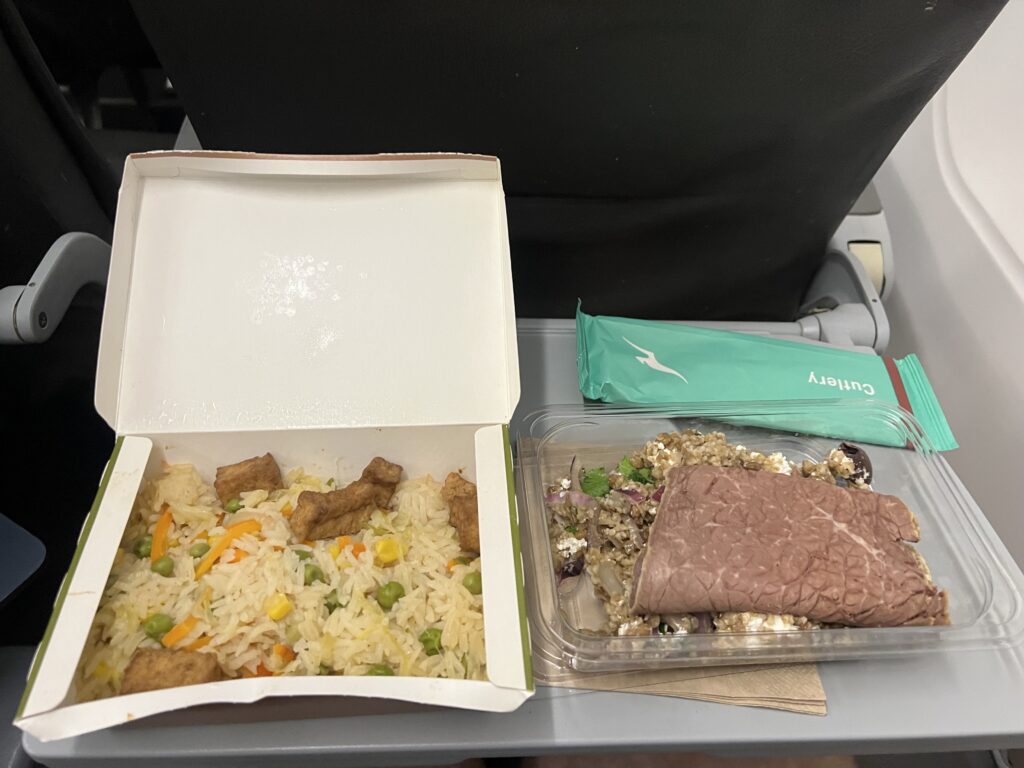
Passengers were offered two dinner options. The first was a cold lentil salad accompanied by sliced beef, while the second consisted of a hot vegetarian tofu and rice dish. Neither option would normally be my first choice, but what impressed me most wasn’t necessarily the menu itself—it was the initiative shown by the cabin crew.
Rather than allowing unused meals to go to waste, I was kindly offered both dinner options. From my experience flying with Qantas over the years, this occasionally happens when there is surplus catering onboard, and it’s always a thoughtful gesture that reflects positively on the crew. It’s a simple act, but one that demonstrates good customer service while simultaneously reducing food waste.
Although the meals themselves weren’t particularly memorable from a culinary perspective, they were fresh, well-presented and perfectly adequate for a domestic evening flight. More importantly, the service was delivered efficiently, professionally and with genuine friendliness throughout the cabin.
Drinks Service
Accompanying dinner was Qantas’ familiar complimentary bar service.
Unlike many low-cost carriers where every drink comes at an additional cost, Qantas continues to include a wide selection of alcoholic and non-alcoholic beverages within the ticket price. It remains one of the airline’s strongest selling points, particularly on longer domestic sectors such as Darwin to Perth.
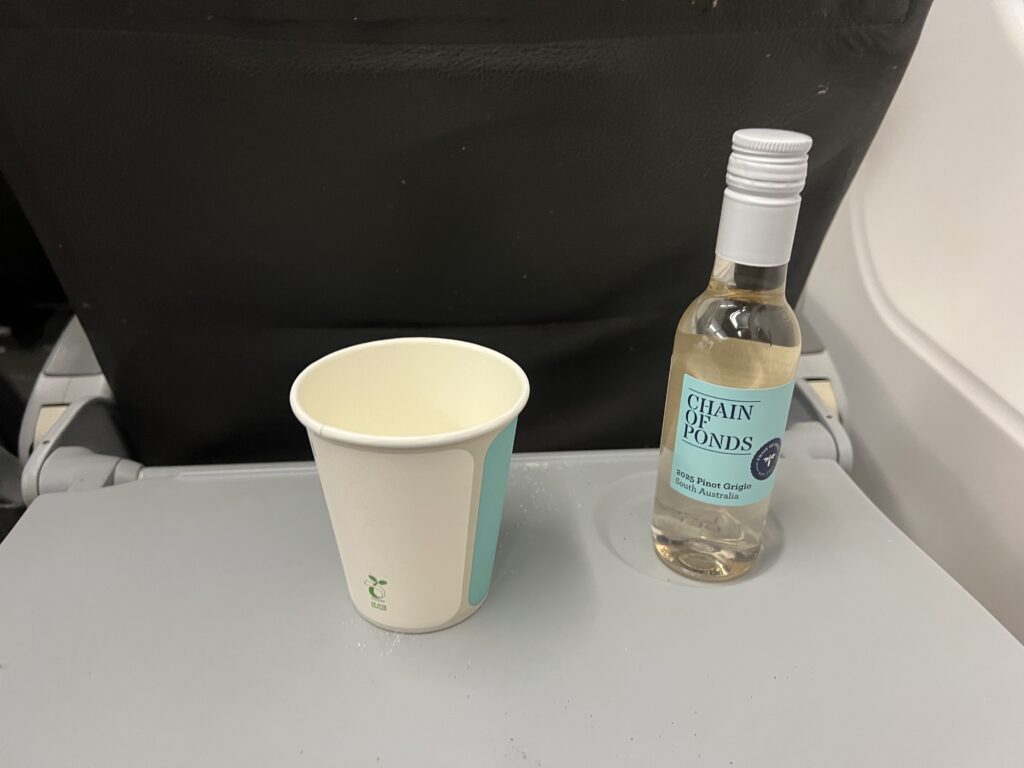
To accompany dinner, I selected a small bottle of Chain of Ponds 2025 Pinot Grigio.
The wine proved to be an enjoyable choice, offering a light, crisp and citrus-driven flavour profile that paired nicely with the meal. Later in the flight, as we began making our way towards Perth, I decided to sample another complimentary beverage, this time opting for a Stone & Wood Pacific Ale.
Stone & Wood has become something of a staple within the Qantas domestic network in recent years, and it’s easy to understand why. As one of Australia’s best-known craft beers, it offers passengers a quality local option rather than simply serving mainstream commercial lagers.
These small touches continue to reinforce the difference between flying Qantas and travelling with a low-cost airline, even aboard an aircraft that still retains much of its Jetstar heritage.
Cabin Crew Deliver the Full Qantas Experience
If there was one aspect of this flight that consistently impressed me from departure through to arrival, it was the professionalism of the cabin crew.
Throughout the journey they were friendly, approachable and attentive without ever feeling intrusive. Every interaction was handled warmly, meal service progressed efficiently, and the crew maintained a relaxed yet professional atmosphere across the cabin.
It’s often said that an airline’s people can make or break a flight, and that certainly rang true here.
Despite travelling on what is essentially an inherited low-cost aircraft, the onboard service still felt unmistakably Qantas. The crew worked hard to deliver the premium service standards passengers expect from Australia’s flag carrier, and they largely succeeded.
For me, this highlighted an important distinction.
While the physical product may have originated with Jetstar, the onboard hospitality certainly did not.
That professionalism went a long way towards offsetting some of the shortcomings of the ageing cabin interior.
A Quiet Flight Across Australia
With dinner complete and the cabin lights dimmed, the remainder of the journey passed remarkably uneventfully.
Given this was an evening departure, there were naturally very few views outside the window after darkness settled across northern Australia. Anyone wanting to appreciate the spectacular landscapes of the Kimberley, Pilbara and Western Australian interior would certainly be better choosing a daytime service.
Instead, this became one of those flights where passengers simply settled in, watched a movie, read a book or attempted to catch some sleep before arriving home.
Thanks largely to the light passenger load, I was fortunate enough to have an entire row to myself for almost the entire flight.
That extra personal space made a tremendous difference.
Had the aircraft been completely full, I suspect my opinion of the seating would have been considerably less favourable. Having room to stretch out transformed what could have been a rather cramped journey into one that was actually reasonably comfortable.
Sometimes luck plays a surprisingly important role in the overall flying experience.
Descending into Perth
As we began our descent into Perth, the captain advised passengers of scattered cloud and cool evening conditions awaiting our arrival.
After leaving Darwin’s balmy tropical evening temperatures behind, it was immediately obvious that Perth felt considerably colder—a timely reminder that winter in Western Australia is a very different experience to the Northern Territory.
The approach itself was smooth, with only light cloud encountered before landing. We touched down safely ahead of schedule before taxiing to the terminal, where passengers disembarked via the aircraft stairs.
Another positive aspect of the evening was the flight’s punctuality.
Boarding commenced on time, departure occurred exactly as scheduled, and thanks to favourable conditions en route, we actually arrived into Perth earlier than planned.
In an era where delays have become increasingly common across global aviation, an early arrival is always appreciated, particularly after a journey of almost four hours.
Final Verdict: Is QantasLink’s Former Jetstar Airbus A320 Worth Flying?
After nearly four hours in the air between Darwin and Perth, one thing became abundantly clear: this is a flight that is defined by contrasts.
On one hand, you have a genuine full-service Qantas experience, complete with friendly cabin crew, complimentary meals and beverages, solid inflight entertainment and excellent punctuality. On the other hand, you have a 20-year-old Airbus A320 that still carries many of the compromises expected of a low-cost airline rather than Australia’s flag carrier.
It makes for an interesting combination.
The aircraft itself is undoubtedly the weakest part of the experience, yet almost everything else surrounding it demonstrates why Qantas continues to enjoy such a strong reputation among Australian travellers.
An Excellent Ground Experience
Reflecting on the journey as a whole, the experience actually began exceptionally well.
Darwin Airport once again proved itself to be one of Australia’s easiest airports to navigate. From self-service check-in through to baggage drop and security screening, every stage of the departure process was remarkably efficient.
Within only a matter of minutes I had checked my luggage, cleared security and was making my way towards the Qantas Club.
That level of efficiency shouldn’t be underestimated.
When airports operate smoothly, they remove much of the stress associated with air travel, allowing passengers to begin their journey in a far more relaxed frame of mind.
The Qantas Club only strengthened that positive first impression.
Although my visit was unfortunately brief, it remains one of my favourite domestic Qantas lounges anywhere in Australia. Spacious seating, quality food and beverages, attentive staff and an uncrowded atmosphere combine to create an experience that comfortably exceeds many of the airline’s larger capital city lounges.
For travellers with lounge access, it represents an excellent way to begin a flight from Darwin.
Where the Airbus A320 Falls Short
Unfortunately, the aircraft itself tells a different story.
There is simply no escaping the fact that these Airbus A320s were originally designed for Jetstar’s low-cost operation.
Despite their relatively recent transfer into the QantasLink fleet, very little has changed inside the cabin. The original slimline leather seating remains, legroom is noticeably tight, and the overall cabin lacks many of the refinements passengers now expect from a premium domestic airline.
On shorter flights of an hour or two, these shortcomings are certainly easier to overlook.
However, on a route approaching four hours, seating comfort becomes a much more significant factor.
For taller passengers in particular, the limited legroom may become uncomfortable well before the aircraft reaches Perth.
Considering Qantas markets itself as Australia’s premium full-service airline, I do believe these aircraft deserve a more comprehensive cabin refurbishment if they are to remain in service for many years to come.
Improved seating alone would dramatically enhance what is otherwise a very competitive onboard product.
Service Continues to Be a Strength
Thankfully, the onboard service goes a long way towards compensating for the ageing cabin.
Throughout the flight the crew were warm, professional and genuinely hospitable, delivering exactly the level of service passengers have come to expect from Qantas.
The complimentary meal service, generous beverage selection and willingness to offer surplus meals rather than allowing them to go to waste all contributed positively to the overall experience.
Likewise, the onboard entertainment system provided a respectable selection of movies and television shows, even if the moving map unfortunately failed to function during this particular flight.
While onboard Wi-Fi remains absent from the Network Aviation Airbus A320 fleet, it is my hope that this becomes a future priority as passenger expectations continue to evolve. Internet connectivity has rapidly become an expected feature on longer domestic flights, particularly among business travellers.
Nevertheless, the quality of the cabin crew ensured that service never felt compromised despite the aircraft’s low-cost origins.
Was It Good Value?
For this particular journey I paid AU$469, a fare that is fairly typical for a Qantas domestic service of this length.
Considering the distance travelled, complimentary catering, checked baggage allowance and full-service experience, I believe the ticket represented reasonable overall value in today’s aviation market.
Airfares throughout Australia have remained elevated in recent years due to increasing operating costs, fuel prices and ongoing capacity constraints. When viewed within that context, the fare felt broadly in line with what I would expect to pay for a premium airline operating one of Australia’s longest domestic routes.
That said, greater competition would almost certainly benefit travellers.
The Perth–Darwin market remains relatively limited, and additional services from carriers such as Jetstar could help place downward pressure on fares while offering travellers greater choice.
Final Thoughts
Despite flying aboard an aircraft that still feels unmistakably like its former Jetstar self, I ultimately stepped off this flight with a positive impression.
The seamless airport experience, excellent Qantas Club lounge, punctual operation, friendly crew, quality onboard service and complimentary catering all reflected the strengths that continue to define the Qantas brand.
The only significant disappointment remains the cabin itself.
The former Jetstar seating simply doesn’t align with the expectations many passengers have when booking a Qantas flight, particularly on a sector lasting almost four hours. It is functional rather than comfortable, and that distinction becomes increasingly noticeable the longer you’re onboard.
Even so, I would happily fly this service again.
For me, the positives comfortably outweighed the negatives, and while the aircraft itself may not be particularly inspiring, the people delivering the service ensured it remained an enjoyable journey from start to finish.
Overall Rating: 7/10
The QantasLink Darwin to Perth Airbus A320 delivers an enjoyable and reliable full-service domestic flight, but the ageing ex-Jetstar cabin prevents it from reaching the standard set by the airline’s newer Boeing 737-800 and Airbus A220 fleets. If Qantas eventually refurbishes these inherited A320s with more comfortable seating and modern amenities, they will become a much stronger product. Until then, passengers can still expect excellent service and dependable operations—just don’t expect the cabin to match the premium experience found elsewhere in the Qantas fleet.
Disclaimer: This article has been repurposed from the original transcript of my own flight review on the Aussie JetSetter Youtube channel with the assistance of AI technologies. Please be advised whilst I have taken the utmost care to review and revise this article where necessary to reflect the upmost of accuracy at time of publication please be advised my reviews whether written or in video form are for entertainment and general information purposes only. They reflect the objective views in good faith of the person only whom is presenting them unless otherwise noted. Any decisions you make resulting from consuming my content must take into consideration your own circumstances, research and responsibility as I can not be hold responsible for any inaccuracies or future changes effecting the relativity of such reviews. All Rights Reserved by Aussie JetSetter from 2022 >


